-
We detected your language preference as English. Would you like to switch to the English version for a better experience?
Switch to English
Stay here



In May of this year, Pfizer announced an exclusive license agreement for SSGJ-707, a PD-1/VEGF bispecific antibody developed by 3SBio. Industry insiders had mixed views on the deal's size: the upfront payment of $1.25 billion set a new record for a single innovative drug out-licensing deal from China, with a total potential transaction value exceeding $6 billion.
On July 25, the day after the global licensing agreement took effect, Pfizer held a conference call to elaborate on the logic behind the SSGJ-707 acquisition—how it aligns with Pfizer’s oncology strategy, recent ASCO clinical data, and its potential across multiple cancer types.
Jeff Legos, Chief Oncology Officer at Pfizer, stated: “When viewed through the lens of Pfizer’s established oncology strategy, the alignment with SSGJ-707 is seamless.”
Three key reasons were cited:
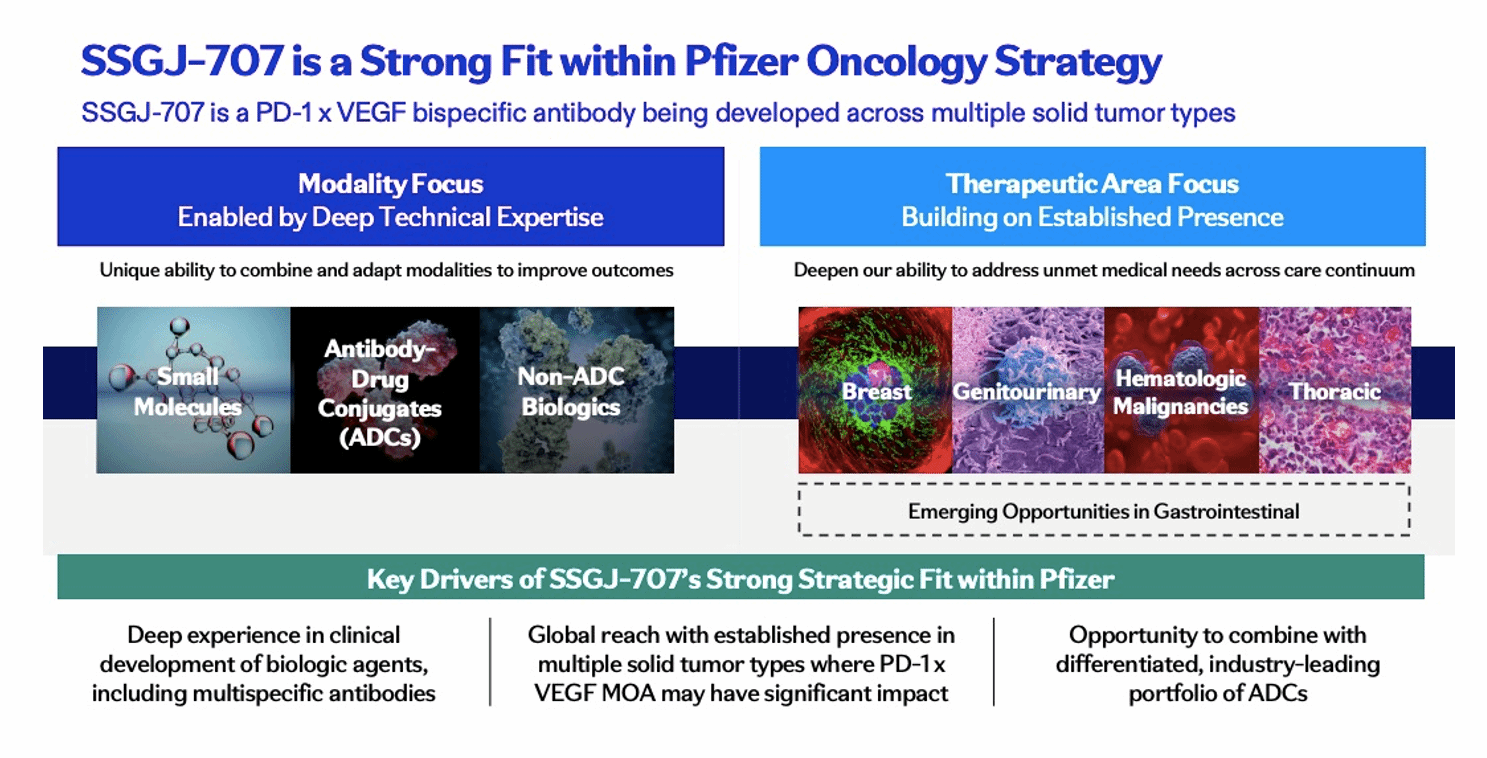
Before selecting SSGJ-707, Pfizer conducted deep due diligence on various PD-1/VEGF bispecifics—especially SSGJ-707—including on-site evaluations at 3SBio. They confirmed the molecule's mechanism of action, preclinical/clinical data, and manufacturing processes were robust and met Pfizer’s transaction standards.
Ultimately, SSGJ-707 was chosen not just for its novel mechanism of action, but also due to its unique molecular design advantages.
SSGJ-707 targets both PD-1 and VEGF in a single agent, combining two powerful and well-validated mechanisms. This not only has the potential to reduce side effects typically seen in combination anti-PD-1 and anti-VEGF therapy, but may also enhance anti-tumor activity via new biological properties.
Globally, multiple PD-1/VEGF bispecifics are in various development stages, with proof-of-concept data supporting the mechanism.
Notably, a Phase III study in NSCLC has shown significant progression-free survival (PFS) improvements compared to PD-1 monotherapy.

From a structural design perspective, SSGJ-707 is a tetrabody—a tetravalent antibody whose two arms independently bind VEGF in the tumor microenvironment and PD-1 on immune cells. These binding regions are not only positioned differently but also exhibit powerful synergistic binding effects.
Binding to one target enhances binding to the other. For example, after SSGJ-707 binds VEGF in the tumor microenvironment, its affinity for PD-1 increases approximately 100-fold. This synergy enhances target binding and may help drive anti-tumor activity.
VEGF is highly expressed in tumors, which may confine activity to the tumor site, potentially improving safety and tolerability. Because VEGF exists as a dimer, it can bind up to two SSGJ-707 molecules. Pfizer believes this “daisy chaining effect” may enhance T-cell binding via PD-1.
Moreover, SSGJ-707 uses a natural IgG4 Fc region with weaker immune activation, potentially limiting inflammatory responses. Other bispecifics often require engineered Fc regions to reduce pro-inflammatory effects.
“Taken together with the current preclinical data, we believe SSGJ-707 may have best-in-class anti-angiogenic activity and exceptionally high affinity for PD-1. This underpins our optimism for its clinical development,” Legos said.
Translating preclinical data to clinical outcomes is a critical challenge in drug development. Phase I and II studies have demonstrated that SSGJ-707 shows anti-tumor activity both as monotherapy and in combination with chemotherapy in several cancers, including NSCLC and metastatic colorectal cancer.
Based on this, Pfizer believes SSGJ-707 has the potential to become a foundational immunotherapy across multiple indications. “The novel mechanism is exciting, but it’s the supporting data that create real value,” Legos emphasized.
Of note, interim data from a Phase II study (presented at this year’s ASCO) evaluated SSGJ-707 as first-line treatment for advanced NSCLC. The 10 mg/kg dose group demonstrated promising efficacy, with an objective response rate (ORR) approaching 65%, showing signs of deep and durable responses. Over time, response curves continued to deepen and were maintained.

At the 10 mg/kg dose, safety was manageable: the most common treatment-related adverse events (TRAE) occurred in about 30% of patients, grade 3 or higher TRAEs in about 23.5%, and treatment-related serious adverse events (SAEs) in about 20%. TRAEs leading to discontinuation were rare, with no treatment-related deaths.
Subgroup analysis showed broad benefit across groups. At 10 mg/kg, ORR and disease control rate (DCR) were comparable across squamous vs. non-squamous histologies and among different PD-L1 expression levels (as measured by TPS score).
“These results are encouraging!” said Legos. “It’s often difficult for therapies to be effective in both squamous and non-squamous NSCLC, and patients with low PD-L1 expression usually have lower response rates. But SSGJ-707 showed similar efficacy to high PD-L1 expressers in this group.”

He also noted that focusing only on ORR may underestimate SSGJ-707’s clinical benefit—especially in NSCLC patients with cavitary lesions. These lesions may skew CT scan results, making tumor shrinkage appear less dramatic, even when actual anti-tumor activity is significant.
Addressing analyst concerns about the generalizability of Chinese patient data to Western populations, Legos responded that ORR is not viewed in isolation. Waterfall and swimmer plots demonstrate depth and durability of response, boosting confidence. Stable disease (SD) is also important in predicting longer-term outcomes like PFS and OS.
“We’ve already seen early evidence that this type of drug can translate from Chinese (or ex-US) patients to the U.S. and other global populations. As we move to the next phase of development, these studies will be global, multi-center, and pivotal in design.”
Pfizer’s immediate priority is to launch global Phase III trials for SSGJ-707 in NSCLC and other solid tumors. The company also plans to explore the drug’s potential in additional cancers and combinations with its pipeline therapies.
“Especially with ADCs, we’re generating evidence that combination with anti-PD-1 therapy may yield practice-changing outcomes,” Legos added. “All of this highlights the significant opportunity SSGJ-707 offers in strengthening Pfizer’s leadership in innovative cancer therapy.”
 EN
EN
 Agricultural News
 Food News
 Industrial News
 Cosmetic News
 Pharmaceutical News
 Science News
