-
We detected your language preference as English. Would you like to switch to the English version for a better experience?
Switch to English
Stay here



On December 16, Merck (MRK.US) announced in a statement that it would discontinue the development of the anti-TIGIT antibody Vibostolimab and the anti-LAG-3 antibody Favezelimab. These two projects aimed to explore the combination of two immune-oncology drugs in the hope of improving patient survival rates across various cancer types. The termination of these two projects marks the end of the company's efforts in these specific cancer treatment research areas.
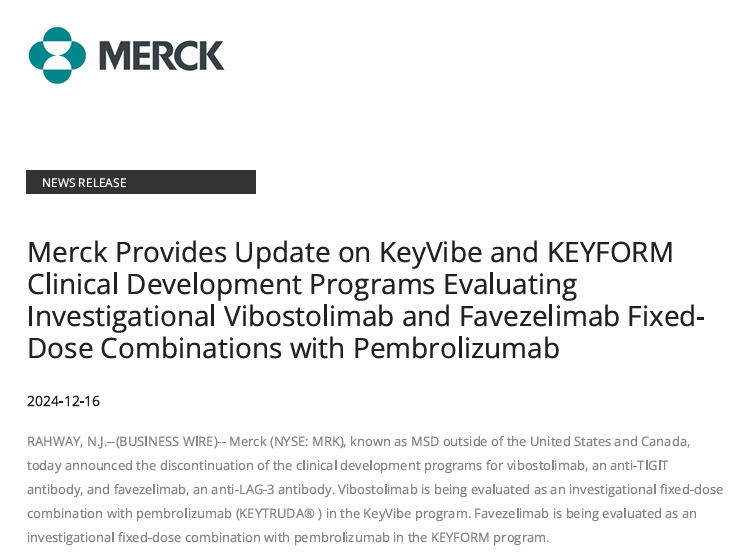
The decision to discontinue these projects was made following safety concerns that emerged over the past several months (particularly with the TIGIT combination), as well as the historical failure record of immune-oncology (IO/IO) combinations.
In pre-specified analyses, both the KeyVibe-003 and KeyVibe-007 studies reached pre-established failure criteria for the primary endpoint of overall survival (OS). Merck stated that immune-related adverse events were more frequent in the fixed-dose combination treatment group compared to the pembrolizumab monotherapy group.
Based on all available data from the existing KeyVibe studies, Merck has decided to terminate the Phase III KeyVibe-006 study and other clinical studies of Vibostolimab.
Furthermore, based on all available clinical data, Merck has also decided to terminate the clinical development program for Favezelimab and discontinue the Phase III KEYFORM-008 study. Patients already enrolled in the study may continue treatment until its completion. The KEYFORM-008 study is the only Phase III trial in the KEYFORM clinical development program that has not yet reported results. Merck emphasized that this termination decision is unrelated to the safety of MK-4280A.
Previously, due to immune-related side effects, Merck also halted a Phase III clinical trial of Keytruda (pembrolizumab) combined with TIGIT as adjuvant therapy for melanoma. In August this year, Merck again terminated a Phase III trial of Keytruda + TIGIT for first-line treatment of small cell lung cancer. Data showed that the primary endpoint for overall survival (OS) failed to meet pre-established criteria. Additionally, the combination regimen had a higher incidence of adverse events compared to the control group.
On November 26, Roche announced that the PD-L1 (Atezolizumab) combined with TIGIT monoclonal antibody tiragolumab did not meet the primary endpoint for overall survival in a Phase III clinical trial for non-small cell lung cancer patients. On July 4, Roche also announced that a Phase II/III clinical trial for non-squamous non-small cell lung cancer did not meet its primary endpoint.
Globally, Roche and Merck have been the most aggressive developers of TIGIT monoclonal antibodies, having pursued development for eight to nine years, with both companies competing for many years.
However, currently, only Roche still has a TIGIT pipeline in Phase III trials. In January this year, Roche’s TIGIT antibody combination therapy for first-line treatment of esophageal squamous cell carcinoma achieved positive results in a Phase III clinical trial. The trial met its dual primary endpoints, with the PD-L1 + TIGIT + chemotherapy regimen significantly improving both progression-free survival and overall survival. Clinical trials for liver cancer are also advancing.
Vibostolimab (MK-7684) is an investigational humanized anti-TIGIT antibody discovered and developed by Merck. Vibostolimab restores anti-tumor activity by blocking the interaction between the TIGIT receptor and its ligands (CD112 and CD155), thereby activating T lymphocytes that contribute to the destruction of tumor cells.
Favezelimab (MK-4280) is an investigational anti-Lymphocyte Activation Gene 3 (LAG-3) antibody. LAG-3 is a cell surface immune regulatory receptor expressed on various immune cells that downregulates T cell proliferation and activation. Favezelimab aims to restore T cell effector function by blocking the interaction between LAG-3 and its primary ligand, major histocompatibility complex (MHC) class II molecules.
 EN
EN
 Agricultural News
 Food News
 Industrial News
 Cosmetic News
 Pharmaceutical News
 Science News
