-
We detected your language preference as English. Would you like to switch to the English version for a better experience?
Switch to English
Stay here




Paraffin (or petroleum wax) is a soft, colorless solid derived from petroleum, coal, or oil shale, consisting of a mixture of hydrocarbon molecules containing 20 to 40 carbon atoms. It is solid at room temperature and starts melting at about 37 °C (99 °F), with a boiling point above 370 °C (698 °F).
What is the therapeutic use of paraffin? Paraffin therapy has a long history in China, where medical paraffin is melted and heated for external application. Historical texts like Compendium of Materia Medica mention the use of thick boiled paraffin for frostbite on the feet. In modern times, paraffin therapy has evolved, integrating traditional wax therapy with acupuncture, herbs, and thermal treatments, offering therapeutic effects that surpass individual treatments.
One of the mechanisms by which paraffin treatment works is by significantly increasing microcirculation, expanding local capillaries, accelerating blood flow, reducing tissue edema, and eliminating pain-causing substances. This helps with the absorption of inflammatory substances, thereby reducing swelling and pain. Additionally, the oil in paraffin helps soften scar tissue and restores elasticity. As paraffin cools, it contracts, creating a mechanical compression effect that prevents lymphatic and blood seepage, enhancing the absorption of exudate. Some researchers believe that paraffin contains mineral oils that chemically stimulate epithelial tissue growth, inhibit bacterial growth, and help superficial skin wounds heal (as shown in the image below).
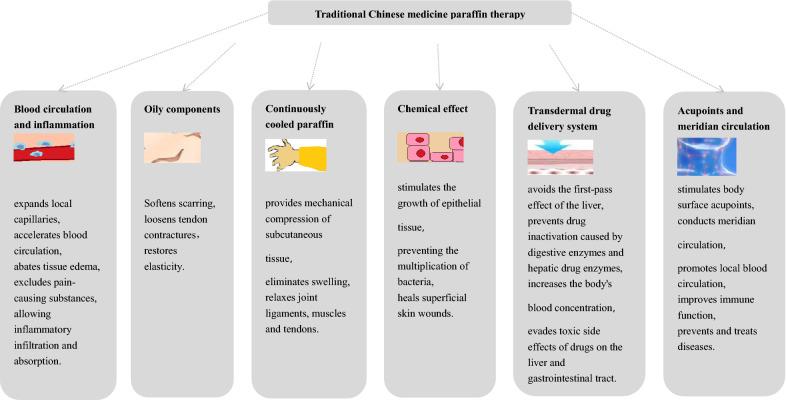
Paraffin in Heat Therapy: Paraffin can be used for heat therapy on the hands or feet. The principle of paraffin heat therapy lies in its thermal conductivity and insulation properties. When body parts are immersed in melted paraffin, its heat is gradually transferred to the skin and deep tissues, dilating blood vessels, increasing local blood flow, and relieving muscle spasms and joint stiffness. It is highly effective in reducing pain and swelling caused by arthritis.
Benefits for Rheumatoid Arthritis Patients: Paraffin baths are mainly used to treat hand abnormalities related to rheumatoid arthritis, degenerative arthritis, and other collagen vascular diseases (such as scleroderma). As a useful form of conductive heat therapy, paraffin can safely heat the affected tissues as long as the liquid paraffin's temperature is checked before application. The paraffin is often mixed with mineral oil (7 parts paraffin to 1 part mineral oil) and placed in a thermostatically controlled heater. The affected area is dipped into the paraffin bath and then removed, allowing the paraffin to solidify. This process can be repeated up to 10 times. The treated area is then placed under an insulating blanket for about 20 minutes, after which the paraffin is peeled off and returned to the heater for reuse. This technique is usually not suitable for joints with acute inflammation and should only be used after anti-inflammatory medications have begun treating the inflammation.
Internal Use of Paraffin: Liquid Paraffin for Constipation Relief: Liquid paraffin is classified as a "laxative" due to its primary function of lubricating or softening stools and forming an oil layer in the intestines. This helps reduce pain from anorectal conditions like hemorrhoids, fistulas, or fissures, thus effectively alleviating constipation. However, is long-term use of liquid paraffin safe? Liquid paraffin can inhibit the absorption of fat-soluble vitamins and, in rare cases, cause lipoid pneumonia due to inhalation of mineral oil. For this reason, this particular type of stool softener is no longer recommended for treating constipation in the elderly.
Paraffin has a large heat capacity, low thermal conductivity, and a long cooling time, making it an excellent heat conduction medium when applied to the body. Paraffin therapy is a truly natural treatment—non-invasive, painless, free of side effects, easy to administer, and cost-effective. It is one of the most effective and recommended rehabilitation methods. Paraffin treatment can offer numerous therapeutic benefits, including:
Although paraffin plays an important role in medicine, the specific methods and doses of use should be adjusted based on a doctor's recommendations to ensure safety and effectiveness. If you have medical needs or questions, consult a physician or healthcare professional for the most accurate guidance and advice.
[1] https://en.wikipedia.org/wiki/Paraffin_wax
[2] https://www.sciencedirect.com/topics/medicine-and-dentistry/liquid-paraffin
[3] https://www.sciencedirect.com/topics/chemical-engineering/paraffin-wax
[4] https://www.ncbi.nlm.nih.gov/pmc/articles/PMC7752303/
[5] Yan W, Liu L, Yang T, et al. Traditional Chinese medicine paraffin therapy: an evidence-based overview from a modern medicine perspective. Chinese Medicine, 2022, 17(1): 106.
 |
 |
 |
 |
 |
 |
 EN
EN
 Agricultural News
 Food News
 Industrial News
 Cosmetic News
 Pharmaceutical News
 Science News

 1YR
1YR

