Welcome to the intriguing world of molecular structures! Today, we'll explore the Lewis structure for C2H3Cl, a compound with significant industrial importance and health implications. Understanding the C2H3Cl Lewis structure is pivotal to grasp its bonding pattern, molecular geometry, and polarity.
What is the Lewis Structures?
Lewis structures, pioneered by Gilbert N. Lewis, are graphical representations of molecular bonding. By depicting valence electrons as dots and bonds as lines, Lewis structures provide insights into a molecule's arrangement and properties. They adhere to the octet rule, which suggests that atoms tend to achieve stability by having eight electrons in their outer shell.
What is Vinyl Chloride?
Vinyl Chloride (C2H3Cl) is an organic compound widely used in the production of polyvinyl chloride (PVC), a versatile plastic with numerous applications in construction, automotive, and healthcare industries. It is a colorless gas with a sweet odor, primarily produced by the chlorination of ethylene.
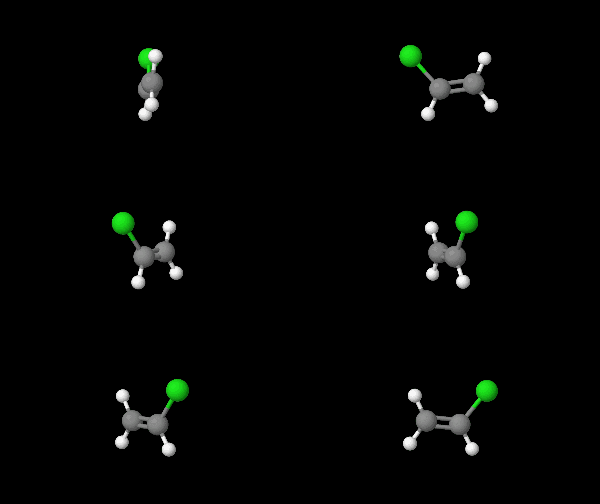
Vinyl Chloride Molecular Structure
How to draw C2H3Cl Lewis structure?
Drawing the C2H3Cl Lewis structure involves the following steps:
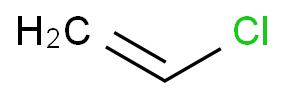
Step 1: Identify the Central Atom: Carbon (C) is the central atom in Vinyl Chloride due to its ability to form multiple bonds.
Step 2: Calculate Total Valence Electrons: Carbon contributes 4 valence electrons, hydrogen contributes 1 each (2 total), and chlorine contributes 7, giving a total of 4 + 2 + 7 = 13 valence electrons.
Step 3: Arrange Electrons Around Atoms: Connect each hydrogen atom to the central carbon atom with a single bond (line) and distribute remaining electrons as lone pairs around chlorine.
Step 4: Fulfill the Octet Rule: Ensure carbon has 8 electrons (4 bonding pairs) and chlorine has 8 electrons (2 lone pairs and 1 bonding pair).
Step 5: Check for Formal Charges: Formal charges may not be necessary as all atoms have achieved the octet rule.

Molecular geometry of Vinyl Chloride
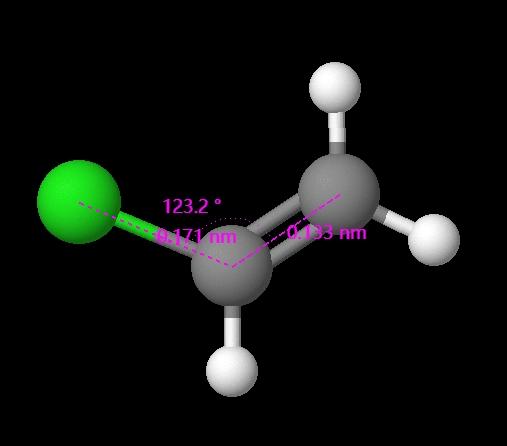
The Lewis structure suggests that Vinyl Chloride adopts a trigonal planar geometry around the central carbon atom. In this arrangement, the two hydrogen atoms and one chlorine atom are symmetrically positioned around the carbon atom, forming a flat triangular shape.
Hybridization in Vinyl Chloride
In Vinyl Chloride, the carbon atom undergoes sp2 hybridization. One s orbital and two p orbitals combine to form three sp2 hybrid orbitals. These orbitals then overlap with the orbitals of hydrogen and chlorine atoms, forming strong σ bonds. This hybridization ensures the stability and planarity of the Vinyl Chloride molecule.
Is Vinyl Chloride polar or nonpolar?
Vinyl Chloride (C2H3Cl) is a polar molecule. The electronegativity difference between carbon (2.55) and chlorine (3.16) results in polar covalent bonds. Additionally, the trigonal planar geometry leads to an uneven distribution of electron density, making Vinyl Chloride polar overall.
What are approximate bond angles and Bond length in Vinyl Chloride?
The bond angle in Vinyl Chloride is approximately 120 degrees. This angle arises from the trigonal planar geometry around the central carbon atom. The bond length between carbon and chlorine in Vinyl Chloride is approximately 177 picometers (pm), while the bond length between carbon and hydrogen is approximately 109 pm.
Note: Actual bond angles and bond lengths may vary slightly depending on factors such as steric hindrance and bond polarity.
Highlight of Vinyl Chloride
| Vinyl Chloride (C2H3Cl) |
| Molecular formula |
C2H3Cl |
| Molecular shape |
Trigonal planar |
| Polarity |
Polar |
| Hybridization |
sp2 hybridization |
| Bond Angle |
Approximately 120 degrees |
| Bond length |
C-Cl: ~177pm, C-H: ~109pm |






 EN
EN
 Agricultural News
 Food News
 Industrial News
 Cosmetic News
 Pharmaceutical News
 Science News

 2YRS
2YRS

