-
We detected your language preference as English. Would you like to switch to the English version for a better experience?
Switch to English
Stay here




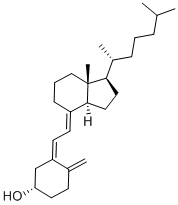
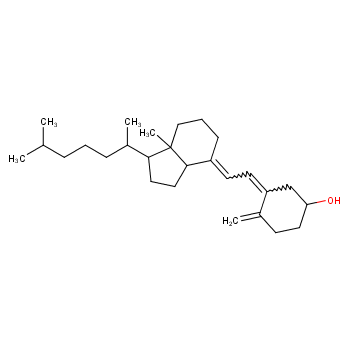
The Lewis structure for Vitamin D67-97-0 visually represents the electron arrangement within the compound. This structure is instrumental in predicting the chemical properties and behavior of Vitamin D67-97-0. It adheres to the octet rule, suggesting that atoms in the molecule aim to achieve stability by having eight electrons in their outer shell.
Vitamin D67-97-0, also known as cholecalciferol, is a vital nutrient essential for bone health, calcium absorption, and various other physiological processes. It is synthesized in the skin upon exposure to sunlight or obtained through dietary sources like fatty fish and fortified foods.

Drawing the Lewis structure for Vitamin D67-97-0 involves several steps:

The molecular geometry of Vitamin D67-97-0 is determined by its Lewis structure, indicating a specific spatial arrangement of atoms. The exact geometry can be deduced from the connectivity and arrangement of atoms within the structure.
This theory explains the electronic structure and bonding interactions within Vitamin D67-97-0, detailing how electrons are distributed across molecular orbitals and the resulting chemical properties of the compound.
The precise molecular geometry of Vitamin D67-97-0 can be determined by analyzing its Lewis structure, revealing the spatial arrangement of atoms and the resulting geometric configuration.
Understanding the hybridization of Vitamin D67-97-0 involves examining the atomic orbitals and the resulting molecular structure, providing insights into the compound's bonding and reactivity.
Determining the bond angles and bond lengths in Vitamin D67-97-0 helps elucidate its physical properties and structure, contributing to a comprehensive understanding of the compound.
| Vitamin D67-97-0 | |
| Molecular formula | C27H44O |
| Molecular shape | Specific geometry determined by its structure |
| Polarity | Nonpolar or polar, depending on the context |
| Hybridization | Specific hybridization determined by its structure |
| Bond Angle | Dependent on its molecular geometry |
| Bond Length | Dependent on its molecular geometry |
A polar molecule can be identified in a Lewis structure by examining the molecular geometry and bond polarity. Polar molecules often exhibit uneven charge distribution, leading to dipole moments. The symmetry of the molecule determines whether these dipole moments cancel out, affecting the molecule's overall polarity.
Calculating the bond energy of Vitamin D67-97-0 involves determining the energy required to break a single bond. Typically, this information is provided in tables of bond energies or can be estimated using empirical methods. For Vitamin D67-97-0, this value would be specific to its structure and can be found in chemical databases or literature.
The bond order in a Lewis structure is calculated by counting the number of shared electron pairs between two atoms. A single bond has a bond order of 1, a double bond has a bond order of 2, and so forth. In Vitamin D67-97-0, the bond order can be determined by examining the number of lines connecting atoms in its Lewis structure.
Electron groups in a Lewis structure refer to both bonding pairs (shared electrons) and lone pairs (non-bonded electrons) surrounding an atom. In Vitamin D67-97-0, electron groups contribute to the molecule's overall geometry and reactivity.
In the Lewis dot structure for Vitamin D67-97-0, the dots represent valence electrons. Each dot corresponds to one valence electron, illustrating the electron distribution and bonding within the molecule.
|
 |
 |
 |
 |
 EN
EN
 Agricultural News
 Food News
 Industrial News
 Cosmetic News
 Pharmaceutical News
 Science News

 13YRS
13YRS

