-
We detected your language preference as English. Would you like to switch to the English version for a better experience?
Switch to English
Stay here




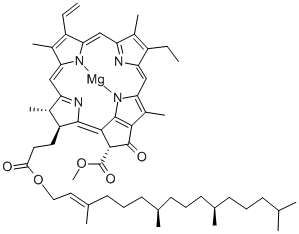
Chlorophyll (CAS 479-61-8) is a green pigment found in plants and algae. It plays a crucial role in photosynthesis, the process through which plants convert light energy into chemical energy. Chlorophyll absorbs light primarily in the blue and red parts of the electromagnetic spectrum, reflecting green light, which gives plants their characteristic green color. It is essential for the growth and survival of photosynthetic organisms.
Chlorophyll (CAS 479-61-8) is a green pigment found in plants and algae. It plays a crucial role in photosynthesis, the process through which plants convert light energy into chemical energy. Chlorophyll absorbs light primarily in the blue and red parts of the electromagnetic spectrum, reflecting green light, which gives plants their characteristic green color. It is essential for the growth and survival of photosynthetic organisms.

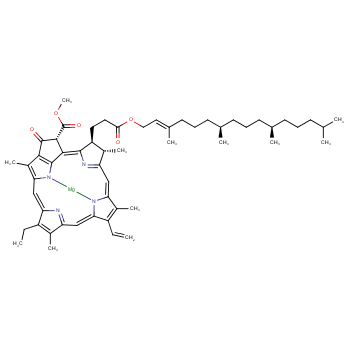
Drawing the Lewis structure for Chlorophyll (CAS 479-61-8) involves several steps. Due to its complexity, we will focus on the general approach:
Step 1: Identify the Central Atom(s): Chlorophyll typically has a magnesium (Mg) atom at the center of its porphyrin ring.
Step 2: Calculate Total Valence Electrons: Chlorophyll contains multiple nitrogen (N), oxygen (O), carbon (C), hydrogen (H), and magnesium (Mg) atoms. Summing the valence electrons for these atoms provides the total number needed for the Lewis structure.
Step 3: Arrange Electrons Around Atoms: Place the Mg atom at the center and connect it with the surrounding nitrogen atoms. Distribute the remaining electrons as lone pairs and bonding pairs around the atoms.
Step 4: Fulfill the Octet Rule: Ensure that each atom (except hydrogen) has a complete octet of electrons. This may involve adjusting the bonds and lone pairs.
Step 5: Check for Formal Charges: Verify that the formal charges are minimized and that the overall structure is stable.

The molecular geometry of Chlorophyll (CAS 479-61-8) is complex due to its large and intricate structure. It generally has a planar porphyrin ring with a central magnesium atom. The overall geometry is influenced by the presence of multiple functional groups and rings, leading to a specific arrangement that facilitates its function in photosynthesis.
Molecular orbital theory explains the distribution of electrons within the complex structure of Chlorophyll. The central magnesium atom forms strong covalent bonds with nitrogen atoms, while the porphyrin ring provides a conjugated system of π electrons. This results in a stable and highly reactive structure that efficiently absorbs light.
The molecular geometry of Chlorophyll (CAS 479-61-8) is complex due to its large and intricate structure. It generally has a planar porphyrin ring with a central magnesium atom. The overall geometry is influenced by the presence of multiple functional groups and rings, leading to a specific arrangement that facilitates its function in photosynthesis.
| Chlorophyll (CAS 479-61-8) | |
| Molecular formula | C55H72MgN4O5 |
| Molecular shape | Planar porphyrin ring with a central magnesium atom |
| Polarity | Polar |
| Hybridization | sp3d2 (magnesium); sp2 (carbon) |
| Bond Angle | Varies due to complex structure |
| Bond length | Varies due to complex structure |
To determine if a Lewis structure is polar, examine the molecular geometry and bond polarity. In the case of Chlorophyll (CAS 479-61-8), the Lewis structure shows a complex arrangement of atoms, including the central magnesium atom and various functional groups. The overall structure is polar due to the presence of multiple polar bonds and asymmetric geometry.
To calculate the total bond energy of Chlorophyll (CAS 479-61-8), look up the bond energies for individual bonds such as C-H, C-C, C-N, and Mg-N. Sum these values to estimate the overall bond energy of the molecule. For example, the bond energy of a typical C-H bond is approximately 413 kJ/mol, and the bond energy of a Mg-N bond can be estimated from similar compounds.
Bond order is the number of chemical bonds between a pair of atoms. In the Lewis structure of Chlorophyll (CAS 479-61-8), most bonds are single bonds, so the bond order for each bond is 1. If there are double or triple bonds, the bond order would be 2 or 3, respectively.
Electron groups in a Lewis structure include both bonding pairs (shared electrons) and lone pairs (non-bonded electrons) around an atom. In Chlorophyll (CAS 479-61-8), each atom has multiple bonding pairs and some lone pairs, contributing to the overall stability and reactivity of the molecule.
In a Lewis dot structure, the dots represent valence electrons. Each dot corresponds to one valence electron of an atom. In Chlorophyll (CAS 479-61-8), the dots help visualize how electrons are shared or paired between atoms, providing insight into the molecule's electronic structure and bonding patterns.
|
 |
 |
 |
|
 EN
EN
 Agricultural News
 Food News
 Industrial News
 Cosmetic News
 Pharmaceutical News
 Science News

 15YRS
15YRS

