-
We detected your language preference as English. Would you like to switch to the English version for a better experience?
Switch to English
Stay here




The Lewis structure, formulated by Gilbert N. Lewis, visually represents the electron distribution within molecules. By illustrating valence electrons as dots and bonds as lines, these structures predict a molecule's shape and properties based on the octet rule, which posits that atoms strive for stability by achieving eight electrons in their outer shell.
Carbon Sulfide (CS2) is a colorless, flammable liquid characterized by its distinctive odour. Composed of one carbon atom bonded to two sulfur atoms, it exhibits a linear molecular structure. It's primarily used in the production of dyes, photographic chemicals, and as a solvent. But What is the structure of CS2?
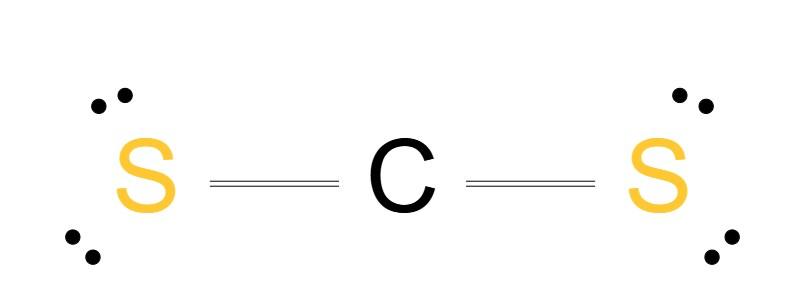
Let's explore how to construct the cs2 lewis structure:
Step 1: Identifying the Central Atom: Carbon (C) is the central atom, since it's less electronegative than sulfur (S).
Step 2: Counting Total Valence Electrons: Carbon contributes 4 valence electrons, and each sulfur atom contributes 6, totaling 4 + (2 x 6) = 16 valence electrons.
Step 3: Arranging Electrons: Connect each sulfur atom to the central carbon atom with a double bond (two lines) and distribute the remaining electrons as lone pairs around each sulfur atom.
Step 4: Fulfilling the Octet Rule: Ensure each sulfur atom has 8 electrons (two lone pairs and one double bond), and the carbon atom has 4 electrons (two lone pairs and one double bond).
Step 5: Checking Formal Charges: Formal charges are not typically considered as the octet rule is satisfied.
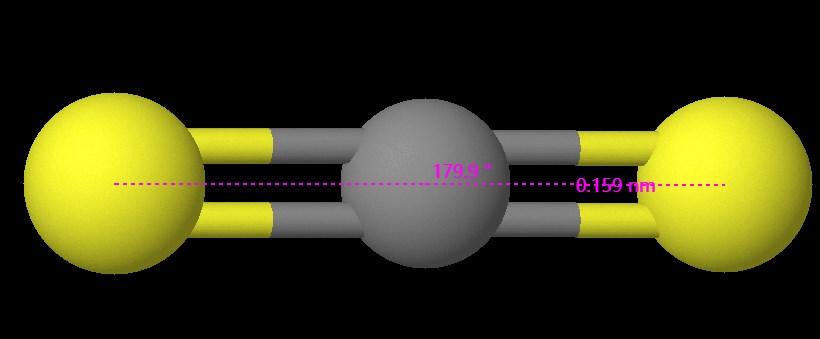
CS2 Lewis structure molecular geometry
What is a Lewis structure for CS2? Is CS2 linear or bent? What molecular shape is CS2? The CS2 molecule adopts a linear geometry due to the arrangement of electron pairs around the central carbon atom. With two sulfur atoms bonded to the carbon atom and no lone pairs, the molecule exhibits a linear shape with a bond angle of 179.9 degrees.
In the molecular orbital theory, the bonding in CS2 involves the overlap of the 2s and 2p orbitals from the sulfur atoms with the 2s orbital from the carbon atom. This results in the formation of two molecular orbitals: the bonding σ2s2p and the antibonding π2p2s. Due to the lack of lone pairs, the molecule maintains a linear geometry with a 180-degree bond angle.
The linear geometry of CS2 arises from the arrangement of electron pairs around the central carbon atom, resulting in a 180-degree bond angle between the sulfur atoms. This configuration minimizes electron repulsion and stabilizes the molecule.
The hybridization of carbon in CS2 involves the mixing of the 2s and 2p orbitals to form two sp hybrid orbitals. These hybrid orbitals then overlap with the p orbitals of the sulfur atoms, facilitating the formation of the two sigma bonds and the stabilization of the linear molecular structure.
In CS2, the bond angle is approximately 179.9 degrees, characteristic of a linear molecule. The bond length is about 0.159 nm, reflecting the strength of the C-S bonds in this compound.
| Carbon Sulfide (CS2) Cas 7783-06-4 | |
| Molecular formula | CS2 |
| Molecular shape | Linear |
| Polarity | Nonpolar |
| Hybridization | sp hybridization |
| Bond Angle | 179.9 degrees |
| Bond length | 0.159 nm |
CS2 lewis structure polar or nonpolar? To ascertain if a lewis structure of cs2 is polar, examine the molecular geometry and bond polarity. For CS2, the linear arrangement and symmetrical distribution of electron pairs around the central carbon atom result in a nonpolar molecule, as the dipole moments cancel each other out.
To calculate the bond energy in CS2, refer to the bond energy of a single C-S bond, which is approximately 310 kJ/mol. Since CS2 contains two C-S bonds, you multiply the bond energy by 2, resulting in a total bond energy of 620 kJ/mol for the CS2 molecule.
The bond order in CS2 is determined by the number of chemical bonds between the atoms. Each C-S bond in the Lewis structure represents a bond order of 1, reflecting the presence of a single bond between carbon and sulfur.
When determining the best Lewis structure for CS2, it's important to consider both the bonding and the arrangement of electrons to ensure the most stable representation. Choosing the correct structure helps in understanding its molecular properties and behavior. If you're exploring how to choose the best Lewis structure for CS2 or other compounds, Guidechem provides access to a wide range of global suppliers of carbon sulfide. Here, you can find the ideal raw materials to support your research and applications.
|
 |
 |
 |
 |
|
 EN
EN
 Agricultural News
 Food News
 Industrial News
 Cosmetic News
 Pharmaceutical News
 Science News

 1YR
1YR

