
What is SeCl4?
Selenium(IV) chloride, with a chemical formula of SeCl4, is a compound known for its significant applications in various chemical processes. It exists as a yellowish-red solid and is commonly referred to as selenium tetrachloride. This compound plays a crucial role in selenium chemistry and is utilized in the synthesis of various selenium-containing compounds.
What is polarity?
Polarity describes the uneven distribution of electrons in a molecule or compound. In chemistry, polarity refers to the distribution of positive and negative charges within a molecule, leading to the molecule having positive and negative poles. This distribution arises due to differences in electronegativity between atoms.
Electronegativity, a measure of an atom's ability to attract electrons, influences the polarity or non-polarity of a bond between two atoms. When there is a significant electronegativity difference between two atoms, typically ranging from 0.5 to 2, one atom attracts the shared electron pair more strongly, resulting in the electron pair being skewed toward one atom, leading to partial positive and negative charges on the atoms involved. Consequently, the molecule exhibits polarity.
Polar molecules demonstrate distinct behaviors in chemical reactions and physical properties such as solubility, melting point, and boiling point. These properties make polar molecules essential in numerous chemical and biological processes.
Polarity of SeCl4
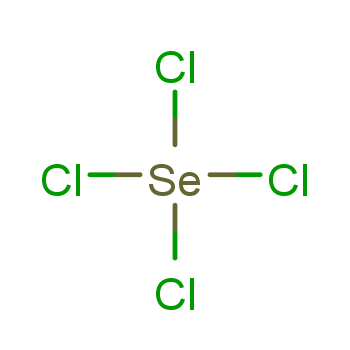
Selenium(IV) chloride exhibits interesting characteristics regarding its polarity. Despite containing four chlorine atoms and one selenium atom, it is a nonpolar molecule. Why is SeCl4 nonpolar?
(1) Dipole Moment
Chlorine, being a highly electronegative halogen, creates polar bonds with the selenium atom, inducing a slight positive charge on selenium. This electronegativity difference generates polar bonds. However, due to the symmetric arrangement of these bonds around the selenium atom, forming a tetrahedral configuration, the dipole moments cancel each other out. Each bond's dipole moment, acting as a vector, counterbalances the dipole moment of its opposite bond, resulting in a
net dipole moment of zero within the SeCl4 molecule.
(2) Electronegativity
Although chlorine atoms possess high electronegativity, their even distribution around the selenium atom prevents significant charge separation within the molecule.
The electronegativity value of selenium(IV) chloride is approximately 2.6, indicating insufficient electronegativity difference to confer polarity.
Therefore,
selenium(IV) chloride, SeCl4, is a nonpolar molecule.
Application of SeCl4 Polarity
Selenium(IV) chloride finds extensive use in organic synthesis, particularly in the preparation of selenium-containing compounds. Its nonpolar nature allows it to dissolve readily in various organic solvents, facilitating reactions and compound isolation. Additionally, SeCl4 serves as a precursor in the production of materials for electronic devices and as a reagent in chemical research.
Highlight of Selenium(IV) chloride
| Selenium(IV) chloride Cas 10026-03-6 |
| Molecular formula |
SeCl4 |
| Molecular shape |
Tetrahedral |
| Relative molecular mass |
233.75 g/mol |
| Solubility |
Insoluble in water, soluble in organic solvents |
| Melting point |
sublimes at 191.4 °C |
| Boiling point |
288°C |




 EN
EN
 Agricultural News
 Food News
 Industrial News
 Cosmetic News
 Pharmaceutical News
 Science News


