-
We detected your language preference as English. Would you like to switch to the English version for a better experience?
Switch to English
Stay here




Carbon tetrachloride, with a chemical formula of CCl4, is a compound that exists as a dense, colorless, and odorless liquid. It is non-flammable and insoluble in water but soluble in many organic solvents such as ether and benzene. This compound can decompose into toxic gases at high temperatures, exhibiting a sweet odor similar to chloroform. Its molecular structure consists of a carbon atom bonded to four chlorine atoms, forming a tetrahedral configuration symmetrically.

Polarity describes the uneven distribution of electrons in a molecule or compound. In chemistry, the polarity of a molecule refers to the uneven distribution of positive and negative charges, resulting in the molecule having positive and negative poles. This uneven distribution is typically due to differences in electronegativity between atoms.
Electronegativity is a measure of an atom's ability to attract electrons. The polarity or non-polarity of a bond between two atoms is determined by the electronegativity of the constituent elements. When there is a significant difference in electronegativity between two atoms, with an electronegativity difference ranging from 0.5 to 2, one atom will attract the shared electron pair more strongly, causing the electron pair in the covalent bond to be skewed toward one atom, giving it a partial negative charge, while the other atom carries a partial positive charge. In this case, the molecule exhibits polarity.
Polar molecules display unique behaviors in chemical reactions and physical properties such as solubility, melting point, boiling point, etc. These properties make polar molecules important in many chemical and biological processes.
Carbon tetrachloride is an intriguing compound because despite being composed of four chlorine atoms and one carbon atom, it is a nonpolar molecule. Why is CCl4 nonpolar?
Chlorine is a halogen with high effective nuclear charge, leading to high electronegativity, causing the carbon atom to carry a slight positive charge. The electronegativity difference between carbon and chlorine results in polar bonds. However, due to the symmetric arrangement of four equally spaced bonds, the molecular structure of carbon tetrachloride is tetrahedral, with the dipole moment pointing toward the more electronegative chlorine atoms, symmetrically distributed around the carbon atom, resulting in relatively uniform electron density in all directions within the molecule. When equal in magnitude and opposite in direction, dipole moments acting as vectors cancel each other out. The dipole moment of one bond cancels out the dipole moment of the opposite bond. Hence, the two pairs of bonds in carbon tetrachloride cancel each other out, resulting in a net dipole moment of zero.
Although chlorine atoms have high electronegativity, the four chlorine atoms are evenly distributed around the carbon atom, attracting electron pairs symmetrically without causing overall charge separation in the molecule. The EN value of carbon tetrachloride is approximately 2.6, indicating that the electronegativity difference between carbon and chlorine is not sufficient to produce significant polarity.
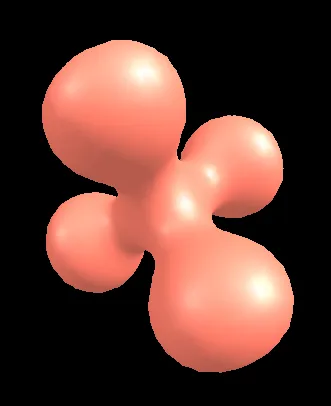
Therefore, carbon tetrachloride, CCl4, is a nonpolar molecule.
Carbon tetrachloride is an organic compound commonly used as a solvent, fire extinguishing agent, and refrigerant. As a solvent, it finds wide applications in organic synthesis, particularly in extraction and compound separation. Its weak polarity grants it good solubility with many organic compounds. Additionally, due to its non-flammability and chemical stability, carbon tetrachloride was once widely used as a fire extinguishing agent. However, its use in fire suppression has greatly diminished with increasing awareness of its toxicity and environmental impact. In the refrigeration industry, carbon tetrachloride was used as a refrigerant, but its use has been phased out due to its ozone-depleting properties.
| Carbon tetrachloride Cas 56-23-5 |
|
| Molecular formula |
CCl4 |
| Molecular shape |
Tetrahedral |
| Relative molecular mass |
153.82 g/mol |
| Solubility |
Insoluble in water, soluble in organic solvents |
| Melting point |
-22.92 °C |
| Boiling point |
76.72 °C |
 |
 |
|
 EN
EN
 Agricultural News
 Food News
 Industrial News
 Cosmetic News
 Pharmaceutical News
 Science News
