-
We detected your language preference as English. Would you like to switch to the English version for a better experience?
Switch to English
Stay here



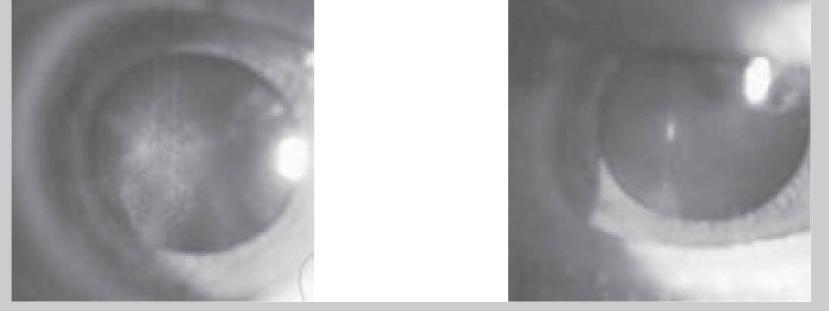
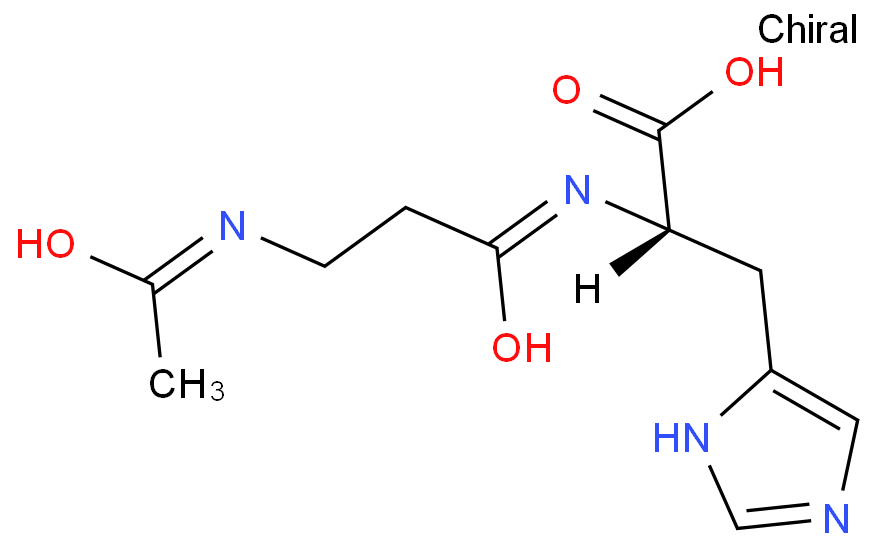
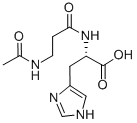
N-Acetyl carnosine, CAS: 56353-15-2, molecular formula: C11H16N4O4, is an English name for N-Acetyl carnosine. Age-related cataracts occur as the lens of the eye becomes cloudy due to oxidation, leading to reduced vision or even blindness. N-Acetyl carnosine acts as a natural oxidation inhibitor, helping to prevent oxidation of the eye's lens. N-Acetyl-L-carnosine eye drops can treat age-related cataracts and have great market potential. Additionally, N-Acetyl-L-carnosine is known for its excellent cosmetic benefits, including anti-wrinkle, anti-aging, and skin repair effects. The structure of N-Acetyl carnosine is as follows:
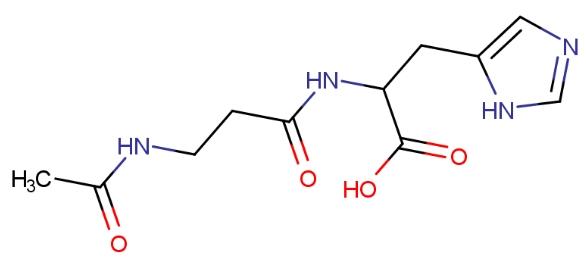
N-Acetyl carnosine (NAC) is a naturally occurring compound chemically related to the dipeptide carnosine. NAC has the same molecular structure as carnosine, except it has an additional acetyl group. N-Acetyl carnosine is a dipeptide and an N-acetyl derivative of carnosine. It functions as a metabolite and is related to carnosine in function. Acetylation makes NAC more resistant to degradation by carnosinase, an enzyme that breaks down carnosine into its constituent amino acids, β-alanine, and histidine.
Topical application of carnosine to the eye surface does not lead to drug penetration into the eye. Therefore, a carrier called N-Acetyl carnosine (NAC) was developed. When NAC is applied to the eye, it penetrates the anterior chamber of the eye through the cornea. Subsequently, NAC is metabolized into the active drug L-carnosine within the eye.
The natural compound Nα-Acetyl carnosine (NAC) is considered a prodrug of L-carnosine (C), resistant to enzymatic hydrolysis by human serum carnosinase. The ophthalmic prodrug NAC and its bioactive component C have advantages as universal antioxidants due to their effective protection of biological membrane lipids and aqueous environments from oxidative stress. N-Acetyl carnosine can be used to treat eye diseases (cataracts, glaucoma, retinal degeneration, corneal diseases, eye inflammation, diabetes complications, systemic diseases) that involve oxidative stress as a contributing factor.
Oral N-Acetyl carnosine
Typical dosage: 500 mg, once or twice daily.
Administration: Oral intake in capsule or powder form.
Ophthalmic N-Acetyl carnosine (Eye Drops)
Dosage: Varies depending on the specific product. Typically, the recommended usage of NAC eye drops is 2 drops in each eye, twice daily.
Application: Apply directly to the eyes as directed on the product label.
Although research on N-Acetyl carnosine is still ongoing, some studies suggest it may have potential benefits for eye health, particularly in cataract treatment. However, more research is needed to draw definitive conclusions. Please remember that the optimal dosage and administration method may vary depending on individual factors and specific health conditions. Be sure to consult a healthcare professional for personalized guidance.
N-Acetyl carnosine is emerging as a popular choice for enhancing health and beauty due to its significant antioxidant and anti-aging effects. It not only helps slow down skin aging but also offers potential protective benefits for eye health. Through scientific research and practical applications, N-Acetyl carnosine has demonstrated unique advantages in various areas.
Want to learn more about N-Acetyl carnosine or purchase high-quality products? Guidechem brings together a wide range of premium N-Acetyl carnosine suppliers. You can easily find and procure the products that meet your needs by visiting the Guidechem website.
[1]https://www.cochranelibrary.com/cdsr/doi/10.1002/14651858.CD009493.pub2/full
[2]https://baike.baidu.com/item/N-%E4%B9%99%E9%85%B0%E8%82%8C%E8%82%BD
[3]https://en.wikipedia.org/wiki/Acetylcarnosine
[4]https://www.sciencedirect.com/science/article/abs/pii/0009898196063565
[5]https://www.ebi.ac.uk/chebi/searchId.do?chebiId=CHEBI:67249
[6]https://www.tandfonline.com/doi/full/10.2147/CIA.S4090
[7]https://pubchem.ncbi.nlm.nih.gov/compound/N-Acetyl-L-carnosine
 |
 |
|
 |
 |
|
 EN
EN
 Agricultural News
 Food News
 Industrial News
 Cosmetic News
 Pharmaceutical News
 Science News

 2YRS
2YRS

