-
We detected your language preference as English. Would you like to switch to the English version for a better experience?
Switch to English
Stay here



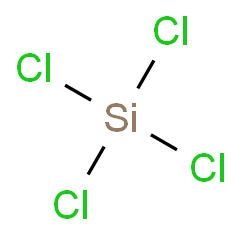
Welcome to the fascinating world of molecules! Today, we'll explore the Lewis structure of tetrachlorosilane(SiCl4), a compound with intriguing properties and applications. Understanding its Lewis structure provides insights into its bonding, geometry, and behavior in various chemical reactions.

Lewis structures, devised by Gilbert N. Lewis, offer a visual representation of electron distribution in molecules. They depict how atoms are bonded together by sharing electrons and provide a basis for understanding a molecule's shape, properties, and reactivity. These structures adhere to the octet rule, ensuring that atoms achieve a stable electron configuration by having eight electrons in their outermost shell.
Tetrachlorosilane (SiCl4) is an inorganic compound widely used in the production of silicon for semiconductors and as a precursor for various silicon-containing compounds. It is a colorless, volatile liquid with a sharp, irritating odor. Tetrachlorosilane is highly reactive due to its silicon-chlorine bonds and finds applications in chemical synthesis and industrial processes.
Drawing the Lewis structure of tetrachlorosilane(SiCl4) involves several steps:
Step 1: Determine the Central Atom: Silicon (Si) is the central atom in SiCl4 due to its lower electronegativity compared to chlorine.
Step 2: Calculate the Total Valence Electrons: Silicon contributes 4 valence electrons, and each chlorine atom contributes 7. The total is 4 + (4 x 7) = 32 valence electrons.
Step 3: Arrange the Electrons Around the Atoms: Start by placing one bonding pair of electrons between silicon and each chlorine atom.
Step 4: Fulfilling the Octet Rule: Each chlorine atom needs one more electron to complete its octet. Add lone pairs around each chlorine atom until all atoms satisfy the octet rule.

The Lewis structure of tetrachlorosilane indicates a tetrahedral molecular geometry. In this arrangement, the four chlorine atoms are positioned symmetrically around the central silicon atom, forming four single bonds. The bond angles between the silicon-chlorine bonds are approximately 109.5°.

In tetrachlorosilane, silicon undergoes sp3 hybridization. This involves the combination of one s orbital and three p orbitals of silicon to form four equivalent sp3 hybrid orbitals. These hybrid orbitals then overlap with the p orbitals of chlorine atoms, resulting in the formation of four sigma bonds.
Tetrachlorosilane is a nonpolar molecule. Although the bonds between silicon and chlorine atoms are polar due to the electronegativity difference, the symmetrical tetrahedral arrangement of the chlorine atoms around the central silicon atom cancels out any net dipole moment, resulting in a nonpolar molecule.
The bond angle in tetrachlorosilane is approximately 109.5 degrees. This angle arises from the tetrahedral geometry around the central silicon atom, where each chlorine atom is positioned at one of the corners of a tetrahedron. Therefore, the angle between any two adjacent chlorine atoms is approximately 109.5 degrees. This angle is consistent with the tetrahedral geometry predicted by the VSEPR theory. The bond length in tetrachlorosilane is approximately 0.203 nm.
| Tetrachlorosilane Cas 10026-04-7 |
|
| Molecular formula |
SiCl4 |
| Molecular shape |
Tetrahedral |
| Polarity |
nonpolar |
| Hybridization |
sp3 hybridization |
| Bond Angle |
109.5 degrees |
| Bond length |
0.203 nm |
 |
 |
 |
 |
|
|
 EN
EN
 Agricultural News
 Food News
 Industrial News
 Cosmetic News
 Pharmaceutical News
 Science News

 4YRS
4YRS

