-
We detected your language preference as English. Would you like to switch to the English version for a better experience?
Switch to English
Stay here




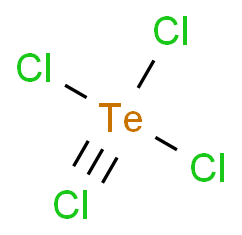
Tellurium tetrachloride (TeCl4) is an inorganic compound consisting of one tellurium atom bonded to four chlorine atoms. It is a colorless gas under standard conditions but becomes yellowish when exposed to light. This compound is highly reactive and is often used in the production of other tellurium compounds. It is also utilized in the field of electronics for certain types of sensors and in the manufacture of pigments and flame retardants.

To draw the Lewis structure for tellurium tetrachloride (TeCl4), follow these steps:

The Lewis structure of TeCl4 suggests that the molecule adopts a tetrahedral geometry. This geometry minimizes electron-electron repulsion and allows each chlorine atom to have a 109.5-degree bond angle with the central tellurium atom.
According to molecular orbital theory, the bonding in TeCl4 can be understood through the overlap of atomic orbitals. The 4s, 4p, 5s, and 5p orbitals of tellurium combine with the 3p orbitals of chlorine to form molecular orbitals. The filled molecular orbitals provide stability, while the empty molecular orbitals can accept additional electrons in certain reactions. This theory helps explain the electronic structure and bonding in TeCl4.
The hybridization of the central tellurium atom in TeCl4 is sp3. This involves the mixing of one s orbital and three p orbitals to create four equivalent sp3 hybrid orbitals. These orbitals facilitate the formation of four sigma bonds with the chlorine atoms, resulting in a tetrahedral molecular geometry.
The bond angle in TeCl4 is approximately 109.5 degrees, characteristic of a tetrahedral geometry. The bond length between tellurium and chlorine atoms is around 228 pm, reflecting the balance between covalent bonding and the repulsion between the electron pairs.
| Tellurium Tetrachloride (CAS Number: 7790-99-0) | |
| Molecular Formula | TeCl4 |
| Molecular Shape | Tetrahedral |
| Polarity | Nonpolar |
| Hybridization | sp3 Hybridization |
| Bond Angle | 109.5 degrees |
| Bond Length | 228 pm |
A Lewis structure can be determined to be polar based on the molecular geometry and the polarity of individual bonds. If the molecule has a symmetrical geometry, like TeCl4 with a tetrahedral shape, and all bonds are of equal polarity, the molecule is considered nonpolar. However, if there is an asymmetrical geometry or the molecule has polar bonds (like those found in water, H2O), it would generally be polar.
Bond energy can be estimated from a Lewis structure by consulting reference data or databases for the bond dissociation energies of the elements involved. For TeCl4, the bond dissociation energy for a Te-Cl bond is approximately 323 kJ/mol. To calculate the total bond energy for the molecule, multiply this value by the number of bonds (in this case, 4). Thus, the total bond energy for TeCl4 is approximately 1292 kJ/mol.
Bond order in a Lewis structure is calculated as the number of electrons in a bond divided by 2. In TeCl4, each Te-Cl bond is represented by a single line in the Lewis structure, indicating that there are 2 electrons per bond. Therefore, the bond order for each Te-Cl bond is 1.
Electron groups in a Lewis structure refer to both bonding pairs (shared electrons) and lone pairs (non-shared electrons) around an atom. In TeCl4, each chlorine atom is represented with 2 lone pairs and 1 bonding pair with the central tellurium atom, totaling 3 electron groups per chlorine atom.
Dots in a Lewis dot structure represent valence electrons of atoms. They indicate the number of electrons that can participate in bonding. In Tellurium Tetrachloride, the dots around the tellurium and chlorine atoms show the valence electrons involved in the formation of the molecule.
|
 |
 |
|
|
 EN
EN
 Agricultural News
 Food News
 Industrial News
 Cosmetic News
 Pharmaceutical News
 Science News

 2YRS
2YRS

