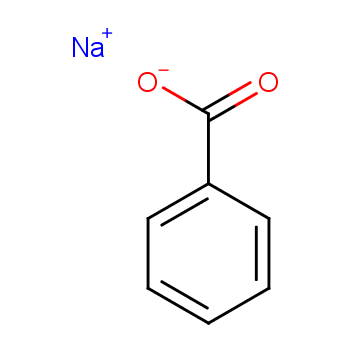
Let's explore the Lewis structure of Sodium benzoate (C7H5O2Na), a compound commonly used as a food preservative and medication. Understanding its Lewis structure sheds light on its bonding pattern, molecular geometry, and properties.

What is the Lewis Structures?
Lewis structures are diagrams that represent the arrangement of atoms and valence electrons in molecules. Proposed by Gilbert N. Lewis, these structures use dots to represent valence electrons and lines to represent covalent bonds. By following the octet rule, Lewis structures predict how atoms bond together, providing valuable insights into molecular properties.
What is Sodium benzoate?
Sodium benzoate is the sodium salt of benzoic acid, with the chemical formula C7H5O2Na. It is a white, crystalline powder that is commonly used as a preservative in various food and beverage products. Apart from its preservative properties, sodium benzoate also finds applications in medicines and cosmetics.
How to draw Lewis structures for Sodium benzoate?
Drawing the Lewis structure of Sodium benzoate involves understanding the bonding and electron arrangement:
Step 1: Identify the Central Atom: Sodium (Na) is the central atom in Sodium benzoate.
Step 2: Calculate Total Valence Electrons: Sodium contributes 1 valence electron, carbon contributes 4, hydrogen contributes 1 each, oxygen contributes 6 each, and there's an additional electron from the sodium ion, giving a total of (1 + 7) + (4 + 1) + (1) + (6 + 6) = 32 valence electrons.
Step 3: Arrange Electrons Around Atoms: Connect each atom with single bonds (lines) and distribute remaining electrons as lone pairs according to the octet rule.
Step 4: Fulfill the Octet Rule: Ensure each atom (except hydrogen) has 8 electrons (or 2 in the case of hydrogen).
Step 5: Check for Formal Charges: Adjust electron distribution if needed to minimize formal charges and achieve the most stable structure.

(Image Source: Wikipedia)
Molecular geometry of Sodium benzoate
The molecular geometry of Sodium benzoate depends on the arrangement of atoms and lone pairs. As Sodium benzoate contains multiple bonds and lone pairs, its geometry is typically non-linear or trigonal planar around the carbon atoms.

Hybridization in Sodium benzoate
In Sodium benzoate, carbon atoms undergo sp2 hybridization. Each carbon atom forms three sigma bonds with other atoms and possesses one unhybridized p orbital, which contributes to the delocalized π system in the benzene ring.
Is Sodium benzoate polar or nonpolar?
Sodium benzoate is a polar molecule due to the presence of polar covalent bonds between carbon and oxygen atoms. Additionally, the asymmetric distribution of electrons in the benzene ring contributes to its overall polarity.
What are approximate bond angles and Bond length in Sodium benzoate?
The bond angles in Sodium benzoate vary depending on the specific carbon atoms and their surroundings, but generally, they tend to be around 120 degrees in the benzene ring. The bond length between carbon and oxygen atoms is approximately 1.20 angstroms.
Note: Actual bond angles and lengths may slightly deviate due to the resonance effect in the benzene ring and other structural factors.
Highlight of Sodium benzoate
| Sodium benzoate Cas 532-32-1 |
| Molecular formula |
C7H5O2Na |
| Molecular shape |
Typically non-linear or trigonal planar |
| Polarity |
polar |
| Hybridization |
sp2 hybridization |
| Bond Angle |
120 degrees |
| Bond length |
120 pm |





 EN
EN
 Agricultural News
 Food News
 Industrial News
 Cosmetic News
 Pharmaceutical News
 Science News

 1YR
1YR

