-
We detected your language preference as English. Would you like to switch to the English version for a better experience?
Switch to English
Stay here



Welcome to the fascinating world of molecular structures! Today, let's delve into the Lewis structure of Silica gel (SiO2), a compound with diverse applications and intriguing chemical properties. Understanding its Lewis structure sheds light on its bonding pattern, molecular geometry, hybridization, and polarity.

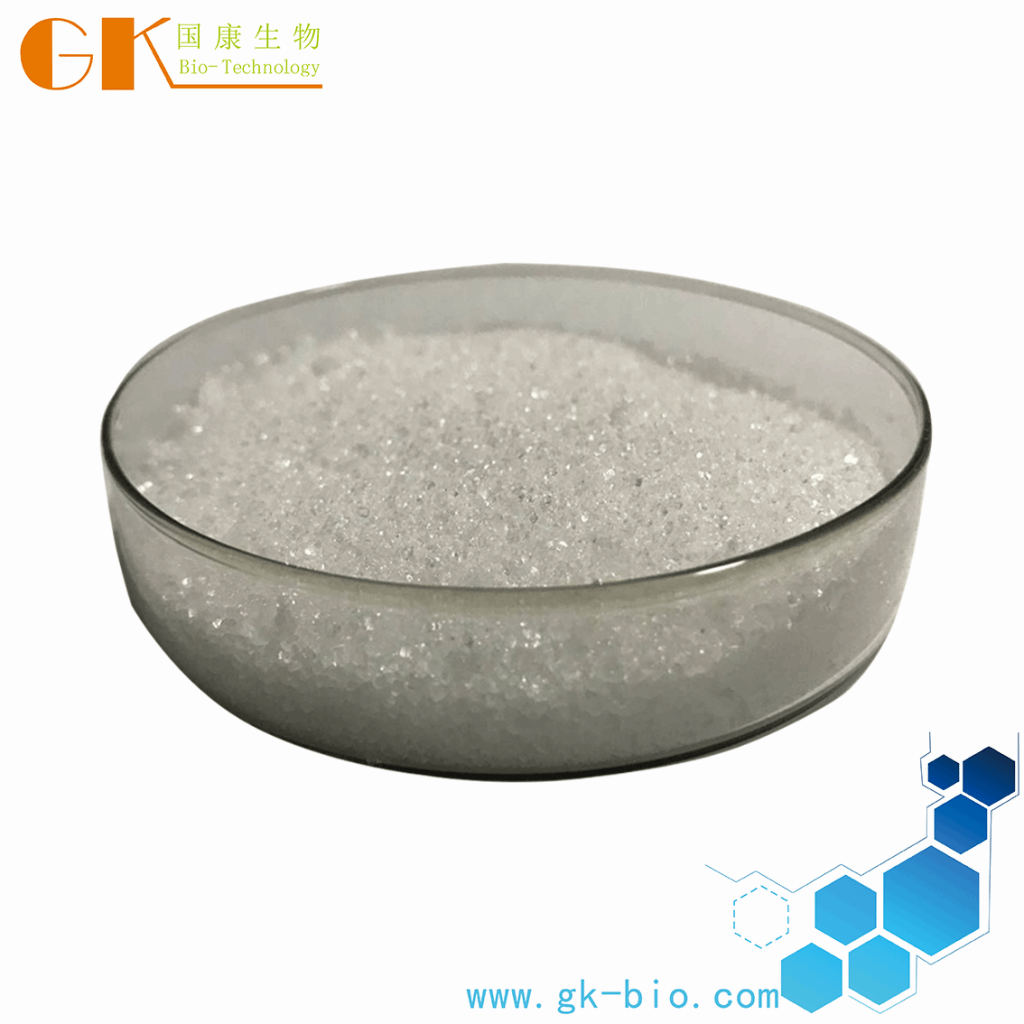
Silica gel, chemically represented as SiO2, is a porous and granular form of silicon dioxide. It finds widespread use as a desiccant to control humidity, as a catalyst support in various chemical reactions, and in chromatography for separating mixtures. Silica gel exhibits excellent adsorption properties due to its high surface area and porosity.

Let's explore the Lewis structure of Silica gel (SiO2):
Step 5: Check for Formal Charges: Formal charges may not be necessary as all atoms have achieved the octet rule.

Silica gel lewis structure
The Lewis structure indicates that Silica gel (SiO2) adopts a bent geometry. In this arrangement, each oxygen atom is bonded to the central silicon atom by a double bond, resulting in a linear molecular shape. The linear geometry minimizes electron-electron repulsion, contributing to the stability of the molecule.
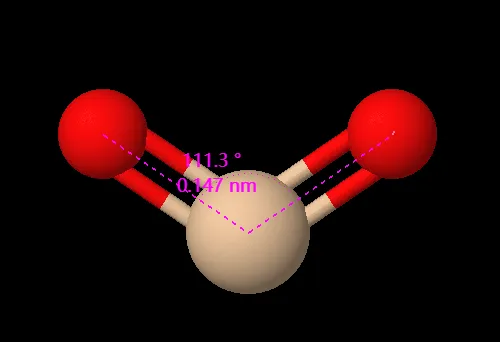
The bond angle in Silica gel (SiO2) is 111.3 degrees, owing to its linear geometry. The bond length between silicon and oxygen atoms is approximately 161 pm. It's important to note that while theoretical calculations predict ideal bond angles, real molecules may deviate slightly due to factors such as lone pair repulsion and bond strain.
| Silica gel Cas 112926-00-8 | |
| Molecular formula | SiO2 |
| Molecular shape | Bent |
| Polarity | nonpolar |
| Hybridization | sp hybridization |
| Bond Angle | 111.3 degrees |
| Bond length | 147 pm |
|
 |
 |
|
 EN
EN
 Agricultural News
 Food News
 Industrial News
 Cosmetic News
 Pharmaceutical News
 Science News

 6YRS
6YRS

