
Welcome to the intriguing world of molecular structures! Today, we'll explore the Lewis structure of K2O, a compound with unique properties and applications. Understanding Lewis structures is key to unveiling how atoms bond in K2O and provides insights into its molecular geometry, hybridization, and polarity.
What is the Lewis Structures?
Lewis structures, devised by Gilbert N. Lewis, visually represent electron arrangements in molecules. By depicting valence electrons as dots and bonds as lines, Lewis structures predict a molecule's shape and properties based on the octet rule. This rule states that atoms tend to achieve stability by having eight electrons in their outer shell. Lewis structures adhere to this rule, offering a clear picture of chemical bonding.
What is Potassium Oxide?
Potassium Oxide (K2O) is an ionic compound formed by the combination of potassium and oxygen. It appears as a white, hygroscopic solid and is primarily used in fertilizers, as well as in glass and ceramic industries. Potassium Oxide reacts readily with water to form potassium hydroxide (KOH), releasing heat in the process.
How to draw Lewis structure of Potassium Oxide?
Let's dive into drawing the Lewis structure of Potassium Oxide:
Step 1: Identify the Central Atom: In K2O, there is no central atom as it is an ionic compound consisting of potassium cations (K
+) and an oxide anion (O
2-).
Step 2: Calculate Total Valence Electrons: Each potassium atom contributes 1 valence electron, and oxygen contributes 6 valence electrons. However, since K2O is ionic, potassium atoms lose their valence electrons to oxygen.
Step 3: Arrange Electrons Around Atoms: Oxygen gains two electrons (one from each potassium), resulting in an O
2- anion with a full octet, while each potassium becomes a K
+ cation.
Step 4: Fulfill the Octet Rule: The oxygen atom achieves stability by having eight electrons in its outer shell, fulfilling the octet rule.
Step 5: Check for Formal Charges: In K2O, the potassium atoms have a +1 charge, and the oxygen atom has a -2 charge, balancing the overall charge to zero.
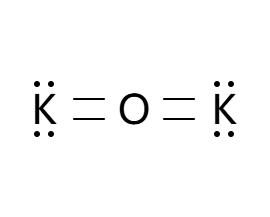
Lewis Structure of Potassium Oxide
Molecular geometry of Potassium Oxide
The molecular geometry of K2O is not typically described in the same way as covalent molecules because it is an ionic compound. However, the arrangement of ions in a solid lattice structure can be considered. Potassium ions and oxide ions form a crystalline lattice where each ion is surrounded by oppositely charged ions, leading to a stable ionic structure.
Hybridization in Potassium Oxide
In K2O, the concept of hybridization is not directly applicable as it is an ionic compound. Hybridization typically describes the mixing of atomic orbitals in covalent bonding. However, in the oxide ion (O
2-), the oxygen atom can be considered to have sp3 hybridization due to the lone pairs of electrons surrounding it.
Is Potassium Oxide polar or nonpolar?
Potassium Oxide (K2O) is an ionic compound, and thus the concept of polarity as applied to covalent molecules does not directly apply. The compound consists of positively charged potassium ions and negatively charged oxide ions, leading to strong ionic bonds rather than polar covalent bonds.
What are approximate bond angles and Bond length in Potassium Oxide?
In K2O, bond angles and bond lengths are not typically described in the same way as in covalent molecules. The bond length in ionic compounds is the distance between the nuclei of the ions. In the crystalline lattice of K2O, this distance depends on the ionic radii of potassium and oxygen. Approximate bond length in K2O is around 278 pm (picometers).
Note: While VSEPR theory provides a good starting point for predicting molecular geometries and bond angles, real molecules can sometimes deviate from the ideal angles due to factors like lone pair repulsion, bond polarity, and molecular interactions.
Higlight of Potassium Oxide
| Potassium Oxide Cas 12136-45-7 |
| Molecular formula |
K2O |
| Molecular shape |
Ionic lattice |
| Polarity |
Ionic |
| Hybridization |
Not applicable |
| Bond Angle |
Not applicable |
| Bond length |
278 pm |



 EN
EN
 Agricultural News
 Food News
 Industrial News
 Cosmetic News
 Pharmaceutical News
 Science News

 4YRS
4YRS


