-
We detected your language preference as English. Would you like to switch to the English version for a better experience?
Switch to English
Stay here



Welcome to the intriguing world of molecular structures! Today, we'll explore the Lewis structure of beryllium chloride (BeCl2), a compound with interesting bonding characteristics and industrial applications. Understanding the Lewis structure of BeCl2 is crucial for comprehending its molecular behavior, including its geometry, hybridization, and polarity.
Lewis structures, developed by Gilbert N. Lewis, are diagrams that represent the valence electrons of atoms within a molecule. By depicting electron pairs as dots and covalent bonds as lines, Lewis structures illustrate how atoms are bonded together and predict the shape and properties of molecules based on the octet rule. This rule states that atoms tend to gain, lose, or share electrons to achieve a stable configuration with eight electrons in their outermost shell.
Beryllium chloride (BeCl2) is an inorganic compound composed of one beryllium atom bonded to two chlorine atoms. It exists as a white crystalline solid at room temperature and is highly soluble in polar solvents like water. BeCl2 is commonly used in the production of beryllium metal, as a catalyst in organic synthesis, and as a precursor for other beryllium compounds.
Step 5: Check for Formal Charges: There are no formal charges in the Lewis structure of BeCl2 as all atoms have achieved the octet rule.

(Image Source: Wikipedia)
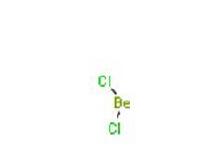
The Lewis structure suggests that BeCl2 adopts a linear geometry. In this arrangement, the two chlorine atoms are symmetrically positioned around the central beryllium atom, forming a linear molecule. This geometry minimizes electron-electron repulsion, resulting in a stable configuration.


(Image Source: Wikipedia)
In BeCl2, the beryllium atom undergoes sp hybridization. One s orbital and one p orbital combine to form two sp hybrid orbitals. These orbitals then overlap with the p orbitals of chlorine atoms, forming two strong σ bonds. This hybridization ensures the stability and linearity of the BeCl2 molecule.
Beryllium chloride (BeCl2) is a nonpolar molecule. Although beryllium is more electronegative than chlorine, the linear arrangement of the two chlorine atoms around the central beryllium atom cancels out any dipole moments, resulting in a nonpolar molecule.
Note: Actual bond angles and lengths may vary slightly due to factors like lone pair repulsion and molecular interactions.
| Beryllium chloride Cas 7787-47-5 | |
| Molecular formula | BeCl2 |
| Molecular shape | - |
| Polarity | nonpolar |
| Hybridization | sp hybridization |
| Bond Angle | - |
| Bond length | 166 pm |
 |
 |
|
 |
 |
 |
 EN
EN
 Agricultural News
 Food News
 Industrial News
 Cosmetic News
 Pharmaceutical News
 Science News

 5YRS
5YRS

