-
We detected your language preference as English. Would you like to switch to the English version for a better experience?
Switch to English
Stay here



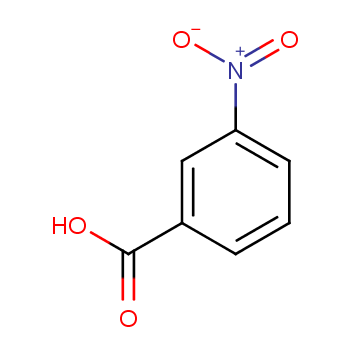
Welcome to the world of molecular structures! Today, we'll delve into the Lewis structure of 3-Nitrobenzoic acid, exploring how its atoms bond and its molecular properties.

Lewis structures, formulated by Gilbert N. Lewis, depict electron arrangements in molecules. By representing valence electrons as dots and bonds as lines, Lewis structures predict molecular shape and properties based on the octet rule, which states that atoms tend to achieve stability by having eight electrons in their outer shell.
3-Nitrobenzoic acid is a compound with the molecular formula C7H5NO4. It consists of a benzene ring substituted with a nitro group (-NO2) at the 3-position and a carboxylic acid group (-COOH) at the 1-position. This compound is commonly used in organic synthesis and as a precursor in the production of pharmaceuticals and dyes.
Step 5: Check for Formal Charges: Adjust electron distribution to minimize formal charges while fulfilling the octet rule.


3-Nitrobenzoic acid is polar due to the presence of the polar nitro group (-NO2) and the carboxylic acid group (-COOH). These functional groups introduce electronegative atoms, leading to uneven electron distribution and a net dipole moment within the molecule.
Note: Actual bond angles and lengths may deviate slightly from ideal values due to factors such as steric effects and resonance.
| 3-Nitrobenzoic acid Cas 121-92-6 | |
| Molecular formula | C7H5NO4 |
| Molecular shape | - |
| Polarity | polar |
| Hybridization | sp2 hybridization |
| Bond Angle | 122 degrees |
| Bond length | N-O: 125 pm |
|
 |
 |
 |
 EN
EN
 Agricultural News
 Food News
 Industrial News
 Cosmetic News
 Pharmaceutical News
 Science News

 13YRS
13YRS

