
What is PBr5?
Phosphorus pentabromide, with a chemical formula of PBr5, is a compound known for its utility in various chemical reactions. It appears as a yellowish-white crystalline solid at room temperature. This compound is highly reactive and serves as a source of bromine in organic synthesis. Despite its importance, PBr5 should be handled with caution due to its corrosive and toxic nature. Is PBr5 polar or nonpolar?
What is Polarity?
Polarity describes the uneven distribution of electrons in a molecule or compound. In the realm of chemistry, polarity signifies the presence of positive and negative poles within a molecule due to an uneven distribution of positive and negative charges. This disparity in charge distribution commonly arises from differences in electronegativity among atoms.
Electronegativity, a measure of an atom's affinity for electrons, plays a pivotal role in determining the polarity of chemical bonds. When there exists a significant difference in electronegativity between two bonded atoms, typically ranging from 0.5 to 2, one atom tends to attract the shared electron pair more strongly, leading to the formation of partial positive and negative charges on the atoms involved. Consequently, the molecule exhibits polarity. Is PBr5 polar or nonpolar?
Polar molecules manifest distinct characteristics in both chemical reactions and physical properties such as solubility, melting point, and boiling point. These attributes render polar molecules indispensable in numerous chemical and biological processes.
Polarity of PBr5
Is PBr5 polar or nonpolar? Phosphorus pentabromide presents an intriguing case regarding its polarity. Despite consisting of five bromine atoms bonded to a central phosphorus atom, PBr5 is a nonpolar molecule. Why is PBr5 nonpolar?
(1) Dipole Moment
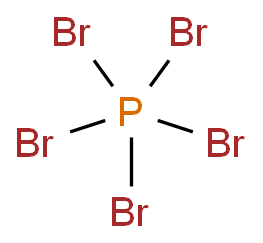
Bromine, being a halogen with considerable electronegativity, induces a slight positive charge on the phosphorus atom. Consequently, polar bonds form between phosphorus and bromine. However, due to the symmetric arrangement of these bonds, resulting in a trigonal bipyramidal molecular geometry, the dipole moments cancel each other out. This cancellation arises from the symmetric distribution of bromine atoms around the phosphorus atom, resulting in a
net dipole moment of zero.
(2) Electronegativity
| Element Electronegativity |
| Br |
2.96 |
| P |
2.19 |
The difference in electronegativity (2.96 - 2.19 = 0.77) is insufficient to create a polar bond.
While bromine atoms exhibit notable electronegativity, their symmetric distribution around the phosphorus atom ensures that electron pairs are attracted uniformly, thereby precluding the emergence of an overall charge separation in the molecule.
The electronegativity difference between phosphorus and bromine in PBr5 is approximately 0.77, underscoring the molecule's nonpolar nature.
Therefore,
phosphorus pentabromide, PBr5, constitutes a nonpolar molecule.
Applications of PBr5 Polarity
Phosphorus pentabromide serves as a crucial reagent in organic synthesis, particularly in bromination reactions. Its nonpolar nature enables it to participate effectively in various chemical transformations where the absence of polarity is advantageous. Additionally, PBr5 finds application in the synthesis of pharmaceuticals, agrochemicals, and materials science.
Highlights of Phosphorus Pentabromide
| Phosphorus Pentabromide Cas 7789-69-7 |
| Molecular formula |
PBr5 |
| Molecular shape |
Trigonal bipyramidal |
| Relative molecular mass |
430.53 g/mol |
| Solubility |
Insoluble in water, soluble in organic solvents |
| Melting point |
≥100°C (decomposes) |
| Boiling point |
106 °C |





 EN
EN
 Agricultural News
 Food News
 Industrial News
 Cosmetic News
 Pharmaceutical News
 Science News

 15YRS
15YRS

