
What is CHCl3?
Chloroform, with a chemical formula of CHCl3, is a compound that exists as a dense, colorless liquid with a distinct, sweet odor. It is non-flammable and only slightly soluble in water but highly soluble in organic solvents such as ethanol and acetone. Chloroform can decompose into phosgene, a toxic gas, when exposed to light and air. Its molecular structure consists of a carbon atom bonded to one hydrogen atom and three chlorine atoms, forming a tetrahedral configuration. An important aspect of molecules like CHCl3 is their polarity, which affects their chemical behavior and interactions. So, is CHCl3 polar or nonpolar?
What is polarity?
Polarity describes the uneven distribution of electrons in a molecule or compound. In chemistry, the polarity of a molecule refers to the uneven distribution of positive and negative charges, resulting in the molecule having positive and negative poles. This uneven distribution is typically due to differences in electronegativity between atoms.
Electronegativity is a measure of an atom's ability to attract electrons. The polarity or non-polarity of a bond between two atoms is determined by the electronegativity of the constituent elements. When there is a significant difference in electronegativity between two atoms, with an electronegativity difference ranging from 0.5 to 2, one atom will attract the shared electron pair more strongly, causing the electron pair in the covalent bond to be skewed toward one atom, giving it a partial negative charge, while the other atom carries a partial positive charge. In this case, the molecule exhibits polarity.
Polar molecules display unique behaviors in chemical reactions and physical properties such as solubility, melting point, boiling point, etc. These properties make polar molecules important in many chemical and biological processes. What about CHCl3? Is CHCl3 polar or nonpolar?
Polarity of CHCl3
Is CHCl3 polar or nonpolar? Chloroform is an interesting compound because it is polar despite having three chlorine atoms. Why is CHCl3 polar?
(1) Dipole Moment
Chlorine is a halogen with high effective nuclear charge, leading to high electronegativity, causing the carbon atom to carry a slight positive charge. The electronegativity difference between carbon and chlorine results in polar bonds. However, the arrangement of these bonds in chloroform is such that it does not cancel out completely. The tetrahedral structure with three chlorine atoms and one hydrogen atom results in a net dipole moment. The electron density is not evenly distributed, making chloroform a polar molecule with a
net dipole moment.
(2) Electronegativity
| Element Electronegativity |
| Cl |
3.16 |
| H |
2.20 |
The difference in electronegativity between chlorine (3.16) and hydrogen (2.20) creates a significant polar bond.
Although chlorine atoms have high electronegativity, the presence of a hydrogen atom breaks the symmetry of the molecule, resulting in an overall charge separation in the molecule.
The electronegativity difference between carbon and chlorine is sufficient to produce significant polarity.
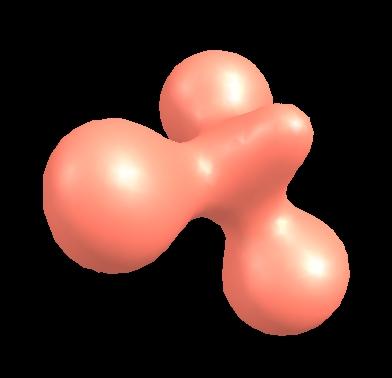
Electron Cloud Model of CHCl3
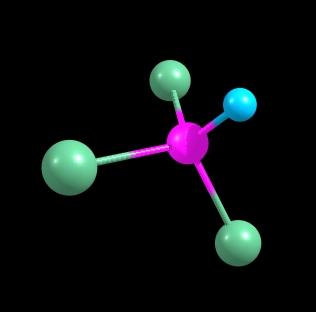
Molecule Structure of CHCl3
Therefore,
chloroform, CHCl3, is a polar molecule.
Application of CHCl3 Polarity
Chloroform is an organic compound commonly used as a solvent, anesthetic, and reagent in laboratories. As a solvent, it finds wide applications in organic synthesis, particularly in the extraction and purification of compounds.
Its polarity grants it good solubility with a variety of organic compounds. Additionally, due to its historical use as an anesthetic, chloroform was once widely used in medical settings. However, its use has diminished with increasing awareness of its potential health risks and the development of safer alternatives. In the laboratory, chloroform is used as a reagent and solvent in various chemical reactions.
Highlight of Chloroform
| Chloroform Cas 67-66-3 |
| Molecular formula |
CHCl3 |
| Molecular shape |
Tetrahedral |
| Relative molecular mass |
119.38 g/mol |
| Solubility |
Insoluble in water, soluble in organic solvents |
| Melting point |
-63.5 °C |
| Boiling point |
61.2 °C |




 EN
EN
 Agricultural News
 Food News
 Industrial News
 Cosmetic News
 Pharmaceutical News
 Science News
