
What is CH3Cl?
Chloromethane, also known as methyl chloride, with a chemical formula CH3Cl, is a compound that exists as a dense, colorless, and volatile liquid. It has a faintly sweet odor and is highly flammable. Chloromethane is soluble in organic solvents like alcohol and ether but is relatively insoluble in water due to its non-polar nature. Polarity is one of the important nature of molecules. Understanding the polarity of CH3Cl is crucial in comprehending its behavior in various chemical reactions. So do you know the polarity of CH3Cl? Is CH3Cl polar or nonpolar?
What is polarity?
Polarity describes the uneven distribution of electrons in a molecule or compound. In the context of chemistry, polarity refers to the separation of electric charge leading to a molecule having positive and negative poles. This uneven distribution arises from differences in electronegativity between atoms within the molecule.
Electronegativity measures an atom's ability to attract electrons. The polarity or non-polarity of a bond depends on the electronegativity of the atoms involved. When atoms with significantly different electronegativities form a bond, the shared electron pair tends to be more strongly attracted to the atom with higher electronegativity, resulting in a partial negative charge on that atom and a partial positive charge on the other atom. This creates a polar bond and may lead to an overall polarity in the molecule.
Polar molecules exhibit distinct behaviors in chemical reactions and physical properties such as solubility and boiling points, making them important in various chemical and biological processes. What about CH3Cl? Is CH3Cl polar or nonpolar?
Polarity of CH3Cl
Is CH3Cl polar or nonpolar? Chloromethane, despite containing a highly electronegative chlorine atom bonded to carbon, is considered a polar molecule. Why is CH3Cl polar?
(1) Dipole Moment
Chlorine, being more electronegative than carbon, pulls the shared electron pair in the C-Cl bond closer to itself, creating a dipole moment where chlorine carries a partial negative charge and carbon carries a partial positive charge. These polar bonds do not cancel each other out due to the asymmetrical arrangement of atoms in CH3Cl, resulting in an overall dipole moment for the molecule.
(2) Electronegativity
| Element Electronegativity |
| Cl |
3.16 |
| C |
2.55 |
The electronegativity difference (3.16 - 2.55 = 0.61) between chlorine and carbon in CH3Cl is sufficient to create a polar bond.
Despite carbon having a lower electronegativity compared to chlorine, the molecular structure of CH3Cl is asymmetrical, with the chlorine atom pulling electron density towards itself, resulting in a molecule with a net dipole moment.

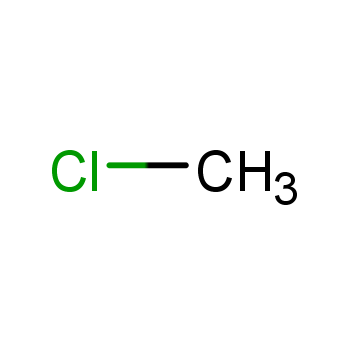
Molecule Structure of CH3Cl

Electron Cloud Model of CH3Cl
Therefore,
chloromethane, CH3Cl, is a polar molecule.
Application of CH3Cl Polarity
Chloromethane is primarily used as an intermediate in the production of silicone polymers and as a methylating agent in organic synthesis. Its polarity enhances its ability to dissolve polar and non-polar substances, making it versatile in various industrial applications.
Highlight of Chloromethane
| Chloromethane Cas 74-87-3 |
| Molecular formula |
CH3Cl |
| Molecular shape |
Tetrahedral |
| Relative molecular mass |
50.49 g/mol |
| Solubility |
Insoluble in water, soluble in organic solvents |
| Melting point |
-97.6 °C |
| Boiling point |
-24.2 °C |





 EN
EN
 Agricultural News
 Food News
 Industrial News
 Cosmetic News
 Pharmaceutical News
 Science News

 5YRS
5YRS

