
What is COS?
Carbonyl sulfide, with a chemical formula of COS, is a chemical compound that exists as a colorless gas with a characteristic odor. It is also known as carbon oxysulfide. This compound is toxic when inhaled and can cause irritation to the respiratory system. Carbonyl sulfide is produced naturally in small quantities by the ocean and volcanoes. It is also formed during the combustion of coal and other fossil fuels. In industrial settings, carbonyl sulfide is produced as a byproduct during the manufacture of carbon disulfide and hydrogen sulfide. Is COS polar or nonpolar?
What is polarity?
Polarity describes the uneven distribution of electrons in a molecule or compound. In chemistry, the polarity of a molecule refers to the uneven distribution of positive and negative charges, resulting in the molecule having positive and negative poles. This uneven distribution is typically due to differences in electronegativity between atoms.
Electronegativity is a measure of an atom's ability to attract electrons. The polarity or non-polarity of a bond between two atoms is determined by the electronegativity of the constituent elements. When there is a significant difference in electronegativity between two atoms, with an electronegativity difference ranging from 0.5 to 2, one atom will attract the shared electron pair more strongly, causing the electron pair in the covalent bond to be skewed toward one atom, giving it a partial negative charge, while the other atom carries a partial positive charge. In this case, the molecule exhibits polarity. Is Carbonyl Sulfide polar or nonpolar?
Polar molecules display unique behaviors in chemical reactions and physical properties such as solubility, melting point, boiling point, etc. These properties make polar molecules important in many chemical and biological processes.
Polarity of COS
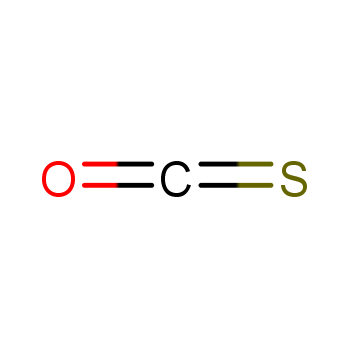
Is Carbonyl Sulfide polar or nonpolar? Carbonyl sulfide is a polar molecule due to the asymmetrical arrangement of atoms and the differences in electronegativity between carbon, oxygen, and sulfur atoms. Why is COS polar?
(1) Dipole Moment
The oxygen atom in carbonyl sulfide is more electronegative than both carbon and sulfur atoms. As a result, the oxygen atom attracts the shared electron pairs more strongly, giving it a partial negative charge, while the carbon and sulfur atoms carry partial positive charges. This creates an overall dipole moment in the molecule, with the oxygen end being more negative and the carbon-sulfur end being more positive.
(2) Electronegativity
| Element Electronegativity |
| C |
2.55 |
| O |
3.44 |
| S |
2.58 |
The difference in electronegativity (3.44 - 2.55 = 0.89) between carbon and oxygen is significant enough to create a polar bond.
The significant electronegativity difference between oxygen and both carbon and sulfur atoms contributes to the polarity of carbonyl sulfide.

Therefore,
carbonyl sulfide, COS, is a polar molecule.
Application of COS Polarity
Carbonyl sulfide has various industrial applications, including its use as a chemical intermediate in the production of thiourea and as a catalyst in chemical reactions. It is also employed in the manufacturing of pesticides, herbicides, and fungicides. Additionally, carbonyl sulfide is utilized in the petroleum industry as a sulfurizing agent and as a precursor in the synthesis of sulfur-containing compounds.
Highlight of Carbonyl sulfide
| Carbonyl sulfide Cas 463-58-1 |
| Molecular formula |
COS |
| Molecular shape |
Linear |
| Relative molecular mass |
60.07 g/mol |
| Solubility |
Slightly soluble in water, soluble in organic solvents |
| Melting point |
-138.8 °C |
| Boiling point |
-50.2 °C |




 EN
EN
 Agricultural News
 Food News
 Industrial News
 Cosmetic News
 Pharmaceutical News
 Science News

 1YR
1YR


