-
We detected your language preference as English. Would you like to switch to the English version for a better experience?
Switch to English
Stay here



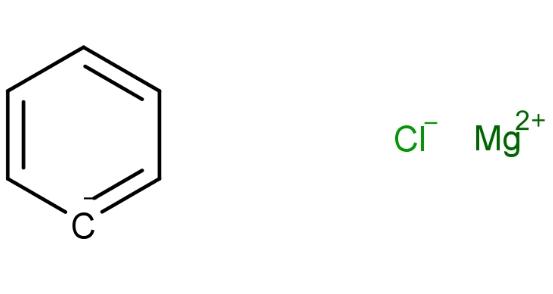
Phenyl magnesium halides are widely used to introduce phenyl groups into organic and organoelemental compounds. Although phenylmagnesium bromide is more reactive and easier to prepare than phenylmagnesium chloride, the latter is often preferred. This is due to the lower cost and higher availability of the initial aryl halide, and phenylmagnesium chloride has a lower tendency to undergo the Wurtz reaction. Ethyl ether is the most common solvent for preparing Grignard reagents; however, the reaction of chlorobenzene with magnesium in this solvent proceeds very slowly, making it unsuitable for preparation. Generally, the synthesis of phenylmagnesium chloride is performed using solvents with higher donor capabilities such as tetrahydrofuran and ethyl ether; however, their use is limited by high costs, fire risks, and explosion hazards. Methods involving the addition of donor solvents in hydrocarbons are widely used, particularly for preparing phenylmagnesium chloride in chlorobenzene with tetrahydrofuran. Phenylmagnesium chloride can be obtained by reacting magnesium with excess chlorobenzene at 160-170°C in a high-pressure reactor, with a yield of about 70%; however, this method has poor industrial applicability. When using a mixture of chlorobenzene and ethyl bromide, the auxiliary method also aids in synthesizing phenylmagnesium chloride; however, the yield is only 39%.
Longzhi et al. reported a method for preparing phenylmagnesium chloride. In this method, chlorobenzene or a mixture of chlorobenzene with Solvent A and Solvent B is used as the first liquid. A mixture of Solvent A and Solvent B is used as the second liquid, and a mixture of magnesium turnings and an initiator is used as the third liquid. Part of the first liquid is first added to the reactor and mixed with the third liquid. The reaction is initiated at a certain temperature, and portions of the first and second liquids are added simultaneously at 90-110°C. The remaining first and second liquids are added simultaneously at 85-95°C over 2–3 hours, maintaining the temperature to obtain a high yield of phenylmagnesium chloride solution. The experimental setup is as follows:

Diagram: 1—Reaction vessel; 2—Magnesium turnings feeding hopper; 3—First liquid measuring tank; 4—Second liquid measuring tank; 5—External circulation pump; 6—Baffle; 7—Tank-mounted jet mixer.
The specific steps are as follows:
Step 1: Use chlorobenzene as the first liquid, with a mixture of toluene and tetrahydrofuran (mass ratio 5:5) as the second liquid. The molar ratio of chlorobenzene to tetrahydrofuran is set at 1:2.1. The third liquid consists of magnesium turnings and initiator, with a molar ratio of magnesium turnings to chlorobenzene in the first liquid at 1.05:1. The initiator is phenylmagnesium chloride solution, with toluene and tetrahydrofuran as solvents, with a solution volume of 20% of the first liquid volume. The concentration of phenylmagnesium chloride in this solution is 25%, and the mass ratio of toluene to tetrahydrofuran is 5:5.
Zhou Liukou et al. reported a continuous production process for phenylmagnesium chloride. The continuous synthesis device includes a dryer, solvent mixing tank, mixed solvent storage tank, magnesium turnings feeder, condenser, first reaction kettle, second reaction kettle, reaction liquid cooling tank, phenylmagnesium chloride storage tank, and chlorobenzene addition channel. These components are connected in sequence via pipelines, with the magnesium turnings feeder and chlorobenzene addition channel connected to the first reaction kettle.

The experimental steps are as follows:
Step 1: Add 2600 liters of toluene and tetrahydrofuran mixture (volume ratio 1:1, water content less than 0.2%) to a 10000-liter reaction kettle, and add 360 kg of magnesium turnings, heating to 60°C. Then, slowly add chlorobenzene at a rate of 250 liters per hour to initiate the reaction. After 1 hour of the initiation phase, add the remaining 2600 liters of toluene and tetrahydrofuran mixture to the reaction kettle, continuing to add chlorobenzene at a rate of 300 liters per hour. The entire addition process lasts 4 to 5 hours until 1300 liters of chlorobenzene is fully added. Meanwhile, slowly raise the temperature to 90-93°C and maintain it for 2 hours. After the reaction, sample analysis should show chlorobenzene content below 1%. Rapidly cool to 30°C, stop stirring, and allow the magnesium turnings to settle. Finally, draw the reaction liquid from the top and transfer it to the next step. The entire process, from feeding to transfer, takes 12 hours.
[1]Zhejiang Wansheng Co., Ltd. A preparation process of phenylmagnesium chloride. 2023-11-10.
[2]Jiangxi Chibang Pharmaceutical Co., Ltd. Continuous synthesis device and method of triphenylphosphine intermediate phenylmagnesium chloride. 2020-09-18.
[3]Grinberg E E, Rakhlin V I, Petrova A A, et al. Synthesis of phenylmagnesium chloride in hydrocarbons[C]//Doklady Chemistry. Nauka/Interperiodica, 2007, 412: 22-23.
[4]Gilman H, St. John N B. The preparation of phenylmagnesium chloride[J]. Recueil des Travaux Chimiques des Pays‐Bas, 1930, 49(8): 717-723.
[5]https://patents.google.com/patent/US2816937A/en
[6]Simuste H, Panov D, Tuulmets A, et al. Formation of phenylmagnesium halides in toluene[J]. Journal of organometallic chemistry, 2005, 690(12): 3061-3066.
 |
|
 |
 EN
EN
 Agricultural News
 Food News
 Industrial News
 Cosmetic News
 Pharmaceutical News
 Science News

 6YRS
6YRS


