-
We detected your language preference as English. Would you like to switch to the English version for a better experience?
Switch to English
Stay here




Penicillin, the inaugural natural antibiotic utilized for the treatment of bacterial infections, remains a pivotal component in the arsenal of antibiotics. Its nomenclature is derived from the fungus genus Penicillium, from which it was initially isolated. The term "penicillin" is generic, encompassing various antibiotic compounds sharing a fundamental structure. Hence, it is more accurate to refer to them collectively as penicillins rather than singularly as penicillin.
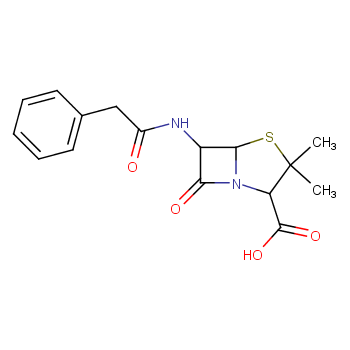
The foundational structure of penicillin comprises a β-lactam ring and a thiazolidine ring fused together, with a peptide bonded to a variable R group. This structure classifies penicillin within the group of compounds known as β-lactam antibiotics. The diverse forms of penicillin depend on the specific R group attached to this fundamental structure. Penicillin primarily acts on the cell walls of bacteria, where the β-lactam rings open in the presence of bacterial enzymes crucial for cell wall formation. By reacting with these enzymes, penicillin deactivates them, disrupting the formation of peptidoglycan cross-links in bacterial cell walls. Peptidoglycans constitute a robust outer skeleton within the bacterial cell. Consequently, penicillin weakens the cell wall, leading to its collapse. Notably, the absence of corresponding cell wall enzymes in human cells renders them unaffected by penicillins.

While Alexander Fleming is generally credited with the discovery of penicillin in 1928, the development of penicillin as an antibiotic unfolded gradually during the late 19th century and the first half of the 20th century. Researchers, including Joseph Lister and Ernest Duchesne, made significant contributions prior to Fleming's work. Fleming's pivotal observation occurred in 1928 when he noticed the inhibition of staphylococci growth in the presence of mold contamination on a Petri dish stored in his laboratory. Despite initial limited interest, Fleming persevered in his work on penicillin, publishing articles in 1929 and 1932. Challenges faced by earlier researchers persisted, hindering significant advancements in understanding the properties of Penicillium.
The commencement of the commercial development of penicillin can be traced back to 1938 when Ernest Boris Chain (1906–1979), a German biochemist who sought refuge in England in 1933, collaborated with Howard Walter Florey (1898–1968) to extend their lysozyme research and explore additional antibacterial agents. Chain, an integral part of Florey’s research team at the Dunn School of Pathology at Oxford University, delved into the literature, with Fleming's 1929 article capturing his attention due to penicillin's resemblance to lysozyme. Chain successfully convinced Florey of penicillin's potential as an antibacterial agent, initiating laboratory work on Penicillium notatum (now called Penicillium chrysogenum) in 1938. However, insufficient research funds from England and Oxford University, coupled with the challenges posed by World War II, initially impeded Florey's efforts to secure support for a project with unclear potential.
The initial challenge faced by the research teams was purifying penicillin by extracting the compound from the mold. Norman Heatley (1911–2004) developed extraction and purification methods to obtain quantities of penicillin sufficient for study. Penicillin's non-toxic nature was confirmed through injections in animal subjects. A crucial experiment in May 1940 involved injecting mice with streptococci bacteria, with half of them treated with penicillin. The mice treated with penicillin survived, demonstrating its efficacy. Subsequent experiments refined the amount and frequency of penicillin injections needed to combat infections in various animal subjects.
The transition to human clinical trials presented a major challenge, requiring the production of sufficient penicillin for human subjects. Initially produced by cultivating Penicillium in clay containers, Heatley's continuous extraction process significantly increased penicillin quantity and purity. Limited trials on human subjects were conducted, utilizing recycled penicillin extracted from subjects' urine. The success of these initial trials showcased penicillin's efficacy in curing infections without harmful side effects, despite some complications.
Florey, unsuccessful in securing financial backing in Britain, traveled to the United States in July 1941. With the help of professional colleagues, Florey arranged a tour to seek support from pharmaceutical companies and agencies. During the tour, a pilot study was arranged at the Bureau of Agricultural Chemistry Lab in Peoria, Illinois, to increase mold production using brewing techniques. Heatley collaborated with Andrew J. Moyer (1899–1959) to develop methods for increased production, using a broth of corn steep liquor and lactose for culturing Penicillium. While Heatley worked on production techniques, Florey continued promoting penicillin to pharmaceutical companies, augmenting their efforts.
Upon Florey's return to Oxford, Heatley remained in the United States to continue work on increasing production. U.S. pharmaceutical firms, driven by the sudden entry into World War II, prioritized commercial penicillin production, beginning mass production in 1943. Penicillin played a pivotal role in treating wounded soldiers, reducing suffering, preventing amputations, curing pneumonia, and saving lives. The United States increased production throughout and after the war, with U.S. firms obtaining patents on production methods. Although there were disputes over credit and royalties, Fleming, Florey, and Chain shared the Nobel Prize in physiology or medicine in 1945 for their work on penicillin.
Three years after the initiation of mass production, the first evidence of resistance emerged. Due to bacteria's ability to develop resistance, pharmaceutical companies continually develop different penicillin compounds. Various forms are used depending on the infection type, delivery method, and individual. Benzylpenicillin or Penicillin G, the form discovered by Fleming and used by Florey, has been joined by numerous compounds classified as penicillins marketed under various trade names. While early penicillins were biosynthetic, modern penicillins are semisynthetic, further synthesized for specific properties. The quest for the structure of penicillin, involving the discovery of several forms, was resolved in 1945 by Dorothy Mary Crowfoot Hodgkin (1910–1994) using X-ray crystallography. John C. Sheehan (1915–1992) later synthesized penicillin V in 1957 at MIT. Despite the impracticality of Sheehan's method on a commercial scale, approximately 45,000 tons of penicillins are produced annually worldwide.
Richard L. Myers (2009). The 100 Most Important Chemical Compounds: A Reference Guide. Greenwood Publishing Group. October 1, 2009. https://doi.org/10.1021/ed086p1182
|
 |
|
|
 EN
EN
 Agricultural News
 Food News
 Industrial News
 Cosmetic News
 Pharmaceutical News
 Science News

 5YRS
5YRS


