-
We detected your language preference as English. Would you like to switch to the English version for a better experience?
Switch to English
Stay here




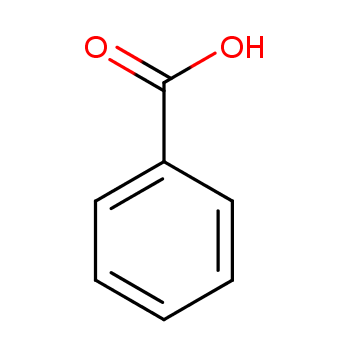
Benzoic acid, also recognized as benzenecarboxylic acid, presents itself as a colorless crystalline solid. It stands as the simplest aromatic carboxylic acid, featuring a carboxyl group (-COOH) directly bonded to the benzene ring. Naturally occurring in the benzoin resin of various plants, benzoin is derived from the bark of balsams within the Styrax genus, predominantly Styrax benzoin and Styrax benzoides. Indigenous to Southeast Asia, S. benzoin was historically traded between Indonesia and China as early as the 8th century CE. Historically, benzoin found applications in fragrances, spices, medicines, and incense. Presently, the majority of benzoin is sourced from Sumatra (Indonesia) and Laos. Healthy trees do not yield benzoin; however, an incision or wound to the cambium results in its secretion, subsequently harvested after solidification.
First isolated by Blaise de Vigenère (1523–1596) in the 16th century from the dry distillation of benzoin, benzoic acid was later prepared by Friedrich W?hler (1800–1882) and Justus von Liebig (1803–1873) through the oxidation of bitter almond oil (benzaldehyde) in 1832. They established the formulas for both compounds and proposed the benzoyl radical (C7H5O) as a precursor to bitter almond oil and benzoic acid. This radical theory played a pivotal role in the early stages of organic chemistry development.

Various synthesis methods for benzoic acid exist, with the industrial approach involving the partial oxidation of toluene (C6H5CH3) in the liquid phase, utilizing catalysts such as manganese, cobalt, vanadium-titanium, at temperatures ranging from 150°C to 200°C. Alternately, benzoic acid can be derived from the oxidation of benzaldehyde, benzyl alcohol (C6H5CH2OH), cinnamic acid (C6H5CHCHO2), or benzene with concentrated sulfuric acid. The hydrolysis of benzonitrile (C6H5CN) also yields benzoic acid. Additionally, benzoic acid is produced through the carboxylation of a Grignard reagent followed by acidification, often involving carbonation with dry ice.
Globally, approximately 750,000 tons of benzoic acid are produced annually, with over 90% being converted into phenol (C6H5OH) or caprolactam (C6H11NO). Caprolactam, employed in the manufacture of nylon and other synthetic fibers, stands as a primary application for benzoic acid.

Sodium benzoate is a significant benzoic acid derivative manufactured on an industrial scale through the neutralization of benzoic acid using sodium hydroxide or sodium bicarbonate solution. Other benzoate salts, such as calcium benzoate and potassium benzoate, are also produced. Both benzoic acid and sodium benzoate (C6H5COONa) find application as food preservatives and are incorporated into acidic foods, juices, and beverages. While benzoic acid exhibits superior antimicrobial properties compared to its salts, sodium benzoate surpasses in solubility, being approximately 200 times more soluble in water, making it the preferred form for preservation. Effective functioning of benzoates requires a pH below 4.5, with improved efficacy at lower pH levels. These salts occur naturally in certain fruits (prunes, plums, apples, cranberries) and their juices.
In the early 1990s, the Food and Drug Administration uncovered a potential reaction between benzoates and ascorbic acid in beverages, leading to the production of benzene, a known carcinogen. In 2005, elevated levels of benzene (> 5 parts per billion) were identified in some drinks, but subsequent surveys of commercial soft drinks have shown either undetectable benzene levels or levels below the established 5 parts per billion limit for drinking water. Sodium benzoate is also employed as a preservative in toothpaste, mouthwashes, cosmetics, and pharmaceuticals. Beyond its application in the food and beverage industry, sodium benzoate serves as an organic corrosion inhibitor. The benzoate ion adheres to metal surfaces, forming a passive layer that impedes oxidation by blocking oxidation sites. This compound is added to engine coolant antifreezes and industrial boilers to prevent corrosion.
Other derivatives of benzoic acid include diethylene glycol dibenzoate (C6H5CO2CH2CH2)2O and dipropylene glycol dibenzoate (C6H5CO2C3H6)2O, which function as esters in plasticizers. These esters are utilized in coatings such as polyvinyl chloride and polyvinyl acetates, as well as in floor coverings and roof coatings. Additionally, they find application in adhesives, sealants, caulks, resins, and paints. Diethylene glycol dibenzoate and dipropylene glycol dibenzoate are incorporated into cosmetics as skin softeners and serve as wetting agents in deodorants. A small quantity of benzoic acid is employed in the production of benzoyl chloride (C6H5COCl) through distillation with phosphorus pentachloride (PCl5). This intermediate is further used in the manufacture of cosmetics, dyes, pharmaceuticals, and resins. Esters like methyl benzoate (C6H5COOCH3) and ethyl benzoate (C6H5COOCH2CH3) result from condensation reactions of benzoic acid and the corresponding alcohol, contributing their fragrant odors to perfumes, cosmetics, and artificial flavorings.
Richard L. Myers (2009). The 100 Most Important Chemical Compounds: A Reference Guide. Greenwood Publishing Group. October 1, 2009. https://doi.org/10.1021/ed086p1182
 |
 |
 |
 |
|
 |
 EN
EN
 Agricultural News
 Food News
 Industrial News
 Cosmetic News
 Pharmaceutical News
 Science News

 2YRS
2YRS


